 LAPEL The Style LAPEL The Style
 Styles are chosen; dress codes are imposed. Between them sits a third category: informal uniforms — emergent signalling patterns that nobody writes down but everyone in a given tribe learns to recognise.
Nobody hands out a Patagonia vest when you join a hedge fund. You show up in a suit, notice that everyone senior is in a vest and a quarter-zip, and within a few months you are dressing like them. The uniform forms organically from accumulated social signals: this is what we wear here; this is what signals we’re one of you.
Most informal uniforms are invisible to outsiders. A non-finance person does not read “Patagonia vest + Oxford button-down” as a uniform — it just looks like someone dressed for the office. The signal works because insiders know to read it. Pointing at the pattern in writing is part of what makes it visible.
This article collects a few recognisable informal uniforms from contemporary adult life. Where the uniform has a documented name, we use it. Where it does not, we flag the label as descriptive — our coinage rather than a fixed term — and cite what is documented about the phenomenon itself.
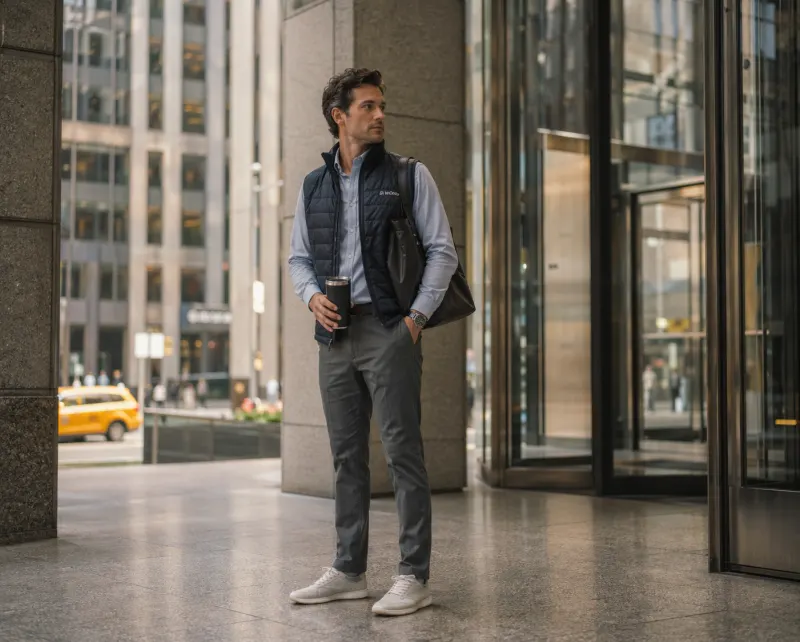
The Wall Street casual.
Name: Attested. Popularised by the Instagram account @midtownuniform around 2017; picked up by the Wall Street Journal, Bloomberg Businessweek, Business Insider, and the Financial Times.
Context: Finance — hedge funds, private equity, venture capital · New York, London, occasionally Hong Kong · mid-2010s to present.
The combination: a branded fleece or quilted vest (Patagonia is the archetype, usually logoed with the wearer’s firm) worn over a blue or white Oxford button-down, mid-grey chinos or dark jeans, and Allbirds Wool Runners. In winter the vest becomes a Patagonia Nano Puff or a Barbour Bedale. Optional add-ons: a company-branded Yeti tumbler, a Tumi tote, a Rolex Submariner or Omega Speedmaster.
The uniform’s origin is particular. Pre-IPO tech companies and hedge funds gave out Patagonia vests with the firm’s logo as new-hire or milestone merch through the 2010s. The vest became a portable status signal — you could tell which fund a junior worked at from the embroidery across a bar — and the rest of the outfit standardised around it. Allbirds rose in parallel through 2016–2020 as Silicon Valley-adjacent capital flowed through Midtown offices.
What it signals, inside the tribe: you work in finance, you make money, you are comfortable enough to dress down, and you are literate in the Midtown signalling vocabulary. Outside the tribe, it reads as “well-dressed for the office” — legible only to those meant to read it.
References: @midtownuniform (Instagram, 2017–); Jian DeLeon at Highsnobiety on Midtown Uniform and office-wear evolution; repeated coverage in WSJ, Bloomberg Businessweek, Business Insider, Financial Times, and Vanity Fair.
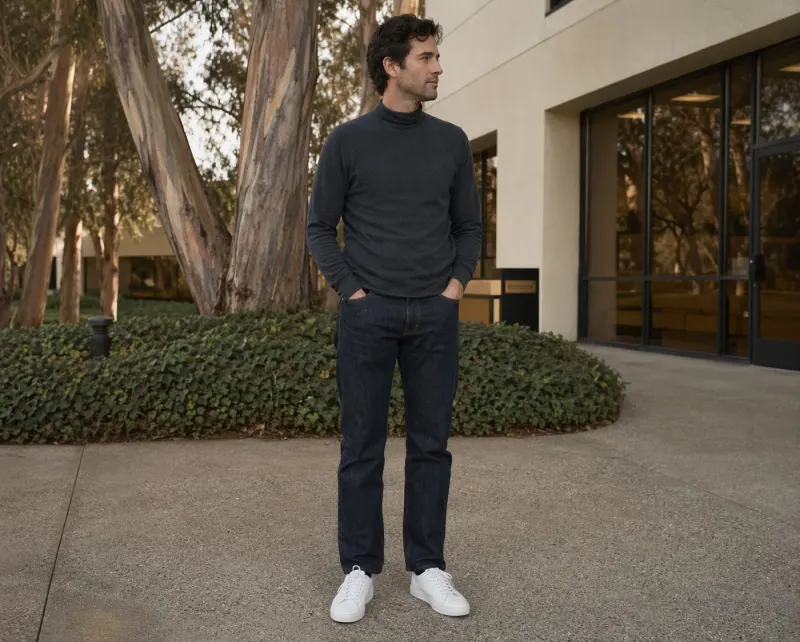
The uniform of the zero-decision wardrobe.
Name: Loosely attested. “Silicon Valley casual” and “tech bro uniform” appear across fashion journalism, but no single canonical label has settled. The individual garments are fixed; the collective name is not.
Context: Startup founders, engineers, early-stage VC · San Francisco, Palo Alto, Seattle · 2010s to present.
The public version: a plain grey or navy T-shirt, dark jeans or tapered sweatpants, minimalist sneakers in white or grey (Allbirds Wool Runners, New Balance 990, Common Projects Achilles). In colder weather a hooded pullover or an Arc’teryx shell; in board rooms the same T-shirt under an unstructured blazer.
Two iconic exemplars anchor the register. Steve Jobs’s black mock-turtleneck (Issey Miyake, made to order) and Mark Zuckerberg’s grey T-shirt (reportedly Brunello Cucinelli, around $300–400 per tee) became shorthand for a post-material stance — I do not spend cognitive budget on what I wear. The uniform does two things at once. It signals that the wearer’s mental energy is allocated elsewhere, a rationale Jobs cited directly. And it signals seniority: nobody senior will tell the wearer to dress up. Junior engineers who copy it read as aspiring to the position rather than occupying it.
References: Walter Isaacson, Steve Jobs (2011); Mark Zuckerberg’s Today show interview (2014) on the grey-T-shirt rationale; Derek Thompson in The Atlantic on decision-minimising wardrobes; coverage across The New Yorker, WIRED, and The New York Times.
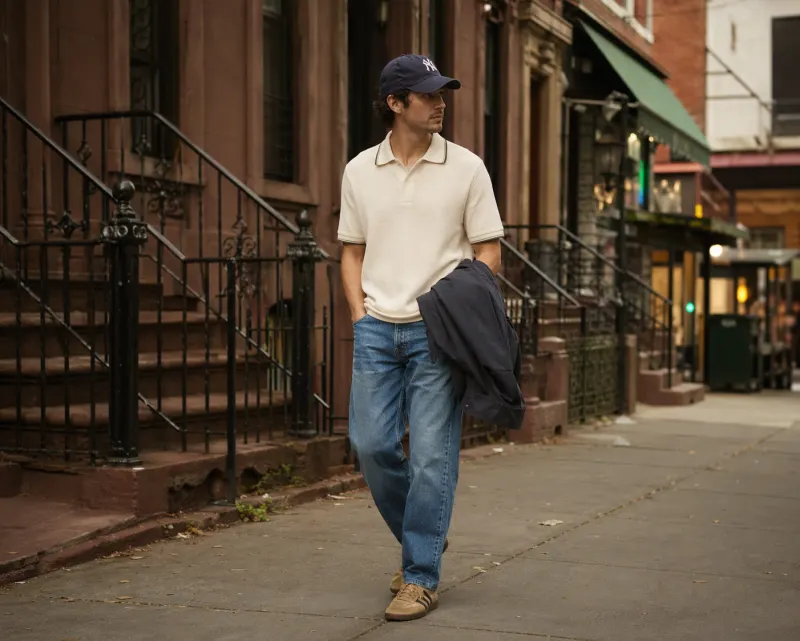
The uniform of New York’s thinking-class weekends.
Name: Descriptive. Our label — no canonical term exists. Earlier “Williamsburg hipster” (mid-2000s to early 2010s) and “Brooklyn dad” (slightly mocking) covered adjacent territory but have fallen out of current use.
Context: Creative industries — media, tech design, music, art · Brooklyn, Queens, Lower Manhattan · mid-2010s to present.
The current register: an Aimé Leon Dore polo or crewneck (or a Stüssy archival reprint, or something from Jacquemus), straight-leg mid-wash denim or a loose drawstring trouser, suede Adidas Sambas or New Balance 550s, a Palace or Yankees cap pulled low. In winter a Carhartt WIP jacket or a boxy Margiela overshirt. The outfit runs roughly fifteen years behind the current fashion cycle — late-1990s and early-2000s sportswear as reference material, worn with knowing affection rather than retro pastiche.
What it signals inside the tribe: fluency in a specific set of menswear brands that communicate taste-within-a-taste — not streetwear’s primary logos, not the Midtown Uniform’s utility, but a literate third position. Outside, the brand-level references are only visible to readers of the same menswear press; everyone else sees well-dressed weekend wear.
References: The New York Times Styles section on Aimé Leon Dore and Brooklyn men’s dress; Highsnobiety’s coverage of ALD; GQ’s “Best Things in Style” (Noah Johnson); SSENSE’s Brooklyn profiles. The phenomenon is documented across the last decade of fashion journalism, though no single text is canonical.
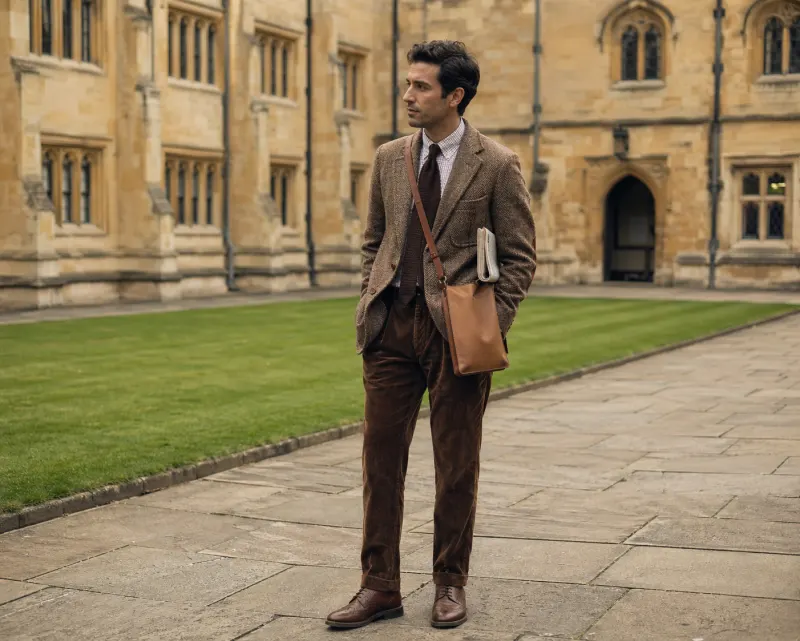
The uniform no tenured professor admits to owning.
Name: Descriptive. Our label — widely parodied (Harrison Ford’s Indiana Jones, Robin Williams in Dead Poets Society, countless adaptations of Evelyn Waugh and C. P. Snow) but not formally labelled in fashion writing.
Context: University faculty, especially humanities and the older sciences · Anglo-American and European · mid-20th century to present.
The archetype: a Harris Tweed sport coat with leather elbow patches, a tattersall or Oxford button-down shirt, brown corduroy or wool odd trousers, and worn brown brogues. Variants: a Barbour jacket in wet weather, a knit tie or bow tie, a Pendleton scarf, occasionally a waistcoat. A leather satchel or a canvas book tote completes it.
The uniform is at once genuine and parodic. It is worn by a subset of older humanities academics, especially in the UK, who learned it from their own professors; the look traces to pre-war English gentleman-scholar dress associated with Oxbridge and the older Ivy colleges. And it is parodically worn by younger academics who know the reference — sometimes unironically, as an aspirational signal of intellectual seriousness; sometimes with a wink, as a way of acknowledging the role they have walked into.
References: Alan Flusser, Dressing the Man (2002), on country-tailoring lineage; G. Bruce Boyer, True Style (2015), chapter on tweed; Harris Tweed Authority on the cloth’s provenance; popular-culture scholarship on academic dress and the professor trope.
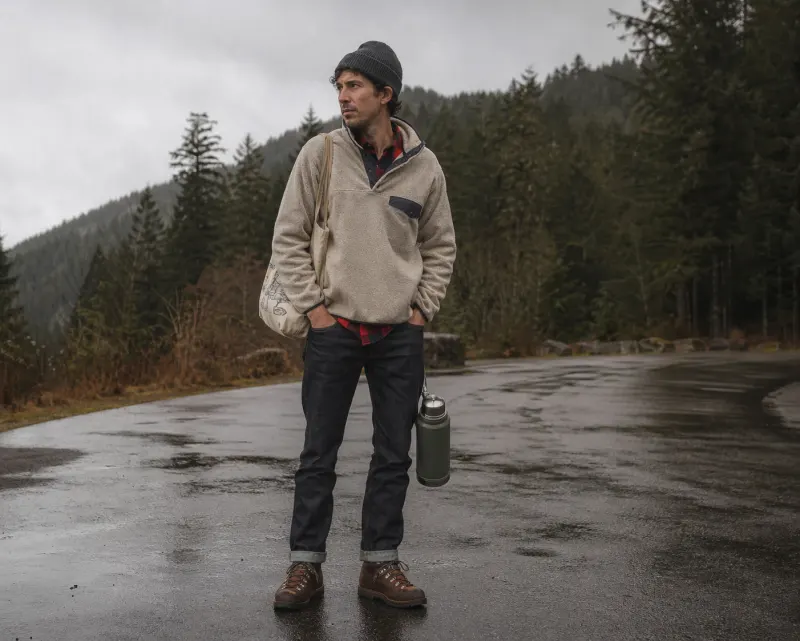
The uniform that treats every Tuesday as a trailhead.
Name: Descriptive. Our label — no single canonical term exists. “PNW style” and “Cascadia casual” appear in lifestyle writing, but neither has settled as a fixed label.
Context: Tech workers, outdoor-industry employees, and the adjacent professional class · Seattle, Portland, Bellingham, Vancouver · 1990s to present.
The combination: a Patagonia Snap-T fleece pullover or a Synchilla in a muted colour, worn over a flannel shirt or a merino base layer; Filson or Carhartt trousers or dark denim; Danner Mountain Light or Blundstone boots; a waterproof shell (Arc’teryx Beta, a Patagonia Torrentshell, or a Cascadia-brand rain jacket) on hand for the six wet months. A knit beanie year-round. A Stanley thermos or a Hydro Flask. A tote bag from an independent bookshop.
The uniform traces to a particular regional infrastructure. Patagonia was founded in California, but the Pacific Northwest produced and still produces much of the technical outdoor wear industry — REI, Filson, Danner, Pendleton, Columbia, Outdoor Research — and a generation grew up with those brands as everyday clothing rather than specialised gear. The grunge lineage (flannel, worn denim, thrifted boots) folded into it through the early 1990s, and the tech-company migration of the late 1990s and 2000s absorbed the look rather than replacing it.
What it signals inside the tribe: that the wearer is locally rooted, is comfortable with weather, and reads clothing through function first. Outside the tribe, especially in other American cities, it reads as mildly underdressed — which is part of the regional self-image. Pacific Northwesterners tend to be proud of not looking like New Yorkers or Angelenos.
References: Patagonia’s own company history (Yvon Chouinard, Let My People Go Surfing, 2005); coverage of grunge-era Seattle in Rolling Stone and The New York Times; Outside magazine on the PNW outdoor-industry cluster; Pendleton Woolen Mills and Filson company archives.
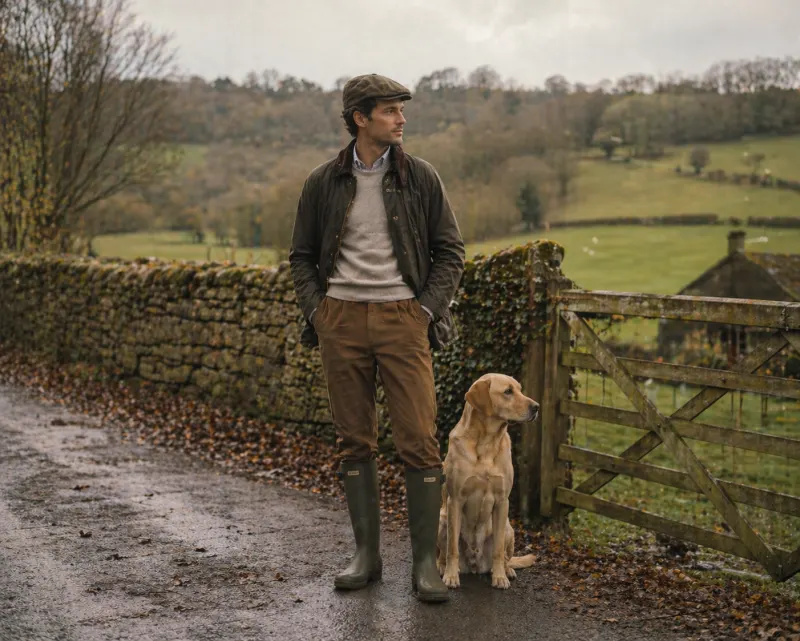
The uniform of the weekend that owns a dog.
Name: Loosely attested. “Country dress” and “county set” are long-standing British terms; specific garments (the Barbour, the wellie, the flat cap) are iconic in their own right; the combination does not have a single fixed label.
Context: Rural British gentry, landowners, and the urban professional class who weekend in the country · Cotswolds, Scottish Borders, Norfolk, the Home Counties · 19th century to present.
The archetype: a waxed Barbour jacket (Bedale, Beaufort, or Border) over a tattersall-check shirt and a lambswool or cashmere crewneck; moleskin or cavalry-twill trousers, or tweed breeks for the shoot; Hunter or Le Chameau wellingtons; a tweed flat cap from Lock & Co. or Laird. For colder days, a quilted gilet, a cable-knit roll-neck, and a tweed shooting jacket. A Labrador or a spaniel is the accessory the uniform was designed around.
The uniform codified through the 19th century around country-house life and field sports — shooting, hunting, fishing, walking — and the garments followed function: wax for rain, tweed for camouflage and warmth, stout leather or rubber boots for mud. Royal patronage cemented specific brands (Barbour holds several royal warrants; Hunter held them for decades before they were revoked in the late 2010s; Purdey for firearms and clothing), and the look remained largely unchanged because the activities remained largely unchanged. Urban Britons who acquired a weekend cottage acquired the wardrobe with it.
What it signals inside: that the wearer has access to the countryside and is fluent in its rhythms — the shoot, the walk, the pub lunch. Outside, especially abroad, it reads as a kind of Britishness that Ralph Lauren has been selling back to the world for fifty years. The signal is partly the clothes and partly the unbothered way they are worn.
References: G. Bruce Boyer, True Style (2015), on country dress; Alan Flusser, Dressing the Man (2002), on British tailoring and country lineage; Harris Tweed Authority; Barbour and Purdey company histories; Country Life magazine as a long-running chronicle of the register.
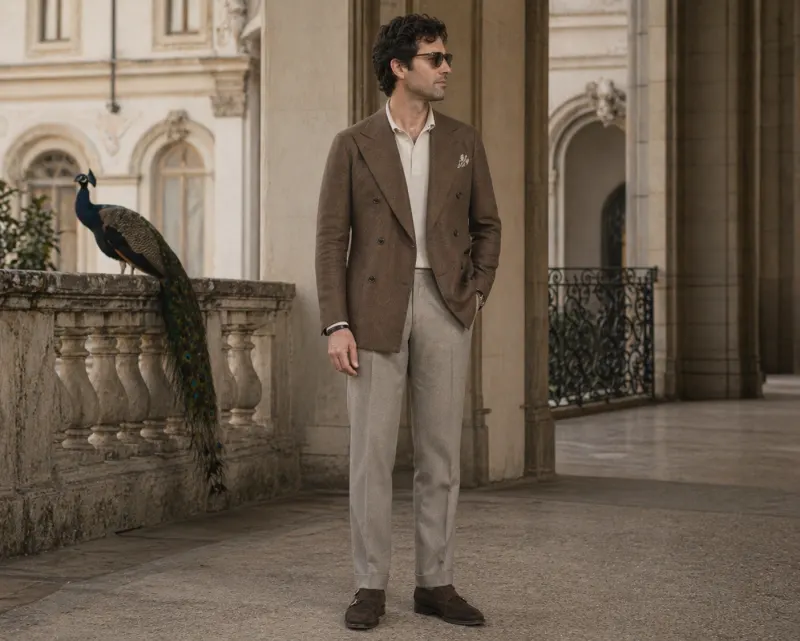
The uniform of the well-paid Milanese lunch.
Name: Loosely attested. “Italian tailoring” and “Pitti peacock” name parts of the register; the whole is often written about without a single label. Simon Crompton’s Permanent Style and menswear blogs of the 2010s treated it as a coherent look.
Context: Italian business class, tailoring industry, menswear enthusiasts · Milan, Florence, Rome, Naples · 20th century to present, with the modern form crystallising through Pitti Uomo coverage in the 2000s and 2010s.
The combination in its serious form: a soft-shouldered, unstructured sport coat in a rich fabric (Neapolitan tailoring from Rubinacci, Attolini, or Kiton, or Brunello Cucinelli’s softer Milanese version); a cashmere crewneck or a fine-gauge polo from Loro Piana; flat-front wool trousers with a clean break; suede loafers or double monks; an unlined overcoat in vicuña or cashmere for winter. Accessories are understated: a simple leather watch strap, a folded linen pocket square, sunglasses. Colour tends to mid-tone and seasonal — greiges, tobaccos, soft blues, warm whites.
The modern register crystallised through Pitti Immagine Uomo, the twice-yearly menswear trade fair in Florence, which became a documentary stage for Italian dress in the 2000s — street-style photographers, particularly Tommy Ton and later The Sartorialist (Scott Schuman), exported the look to a global audience. The peacocking fringe (loud pattern-on-pattern, ankle-baring trousers, exaggerated gestures) was always the minority of attendees; the durable register underneath is what Milanese and Florentine businessmen actually wear — softer, more expensive than it looks, and visually calm.
What it signals inside: craft, money, and an unhurried confidence that the rest of Europe reads as distinctly Italian. Outside, it reads as “well-dressed” in a way most American registers do not achieve, because the tailoring is different and the fabrics are more expensive.
References: G. Bruce Boyer, True Style (2015); Simon Crompton, Permanent Style, on Italian tailoring houses; Pitti Immagine Uomo fair; Scott Schuman, The Sartorialist (2009); Business of Fashion coverage of Brunello Cucinelli and Loro Piana.
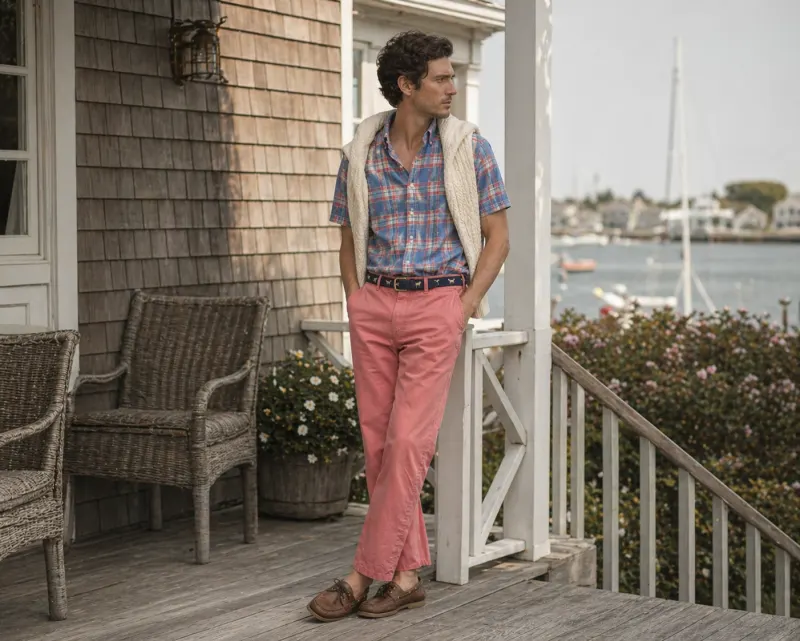
The uniform of the house that has been in the family.
Name: Loosely attested. “Preppy” is canonical (Lisa Birnbach, The Official Preppy Handbook, 1980); the summer subset is often called “Nantucket” or “Vineyard” style in shorthand. “Old money” as a style descriptor gained fresh currency in the 2020s, partly through social-media recycling.
Context: American North-East coastal gentry and the adjacent professional class · Nantucket, Martha’s Vineyard, the Hamptons, coastal Maine, Fisher’s Island · 20th century to present.
The warm-weather register: faded Nantucket Reds from Murray’s Toggery Shop (chinos that fade to a specific dusty pink with wear), a madras shirt or a washed linen button-down, Sperry Top- Siders or penny loafers worn sockless, a cotton crewneck or a cable-knit cricket sweater slung over the shoulders, a woven belt with embroidered whales or lobsters. Fabric is cotton, linen, madras, seersucker. Hair is unfussed, often sun-bleached. A Jack Russell or a golden retriever, again, is part of the composition.
The uniform documented itself through The Official Preppy Handbook (Birnbach, 1980), which was affectionate satire but also an accurate field guide, and through Ralph Lauren’s entire career, which has been a continuous translation of this register into ready-to-wear for a wider audience. The durable version pre-dates both: the specific items (Nantucket Reds from Murray’s Toggery Shop since the 1960s, Sperry Top-Siders since 1935, madras popularised in American preppy dress by Brooks Brothers from the late 1950s) come from genuine coastal-New-England provenance, and families who spent summers on these islands across generations kept wearing them.
What it signals inside: that the wearer belongs to, or is adjacent to, a specific coastal-American social class with summer infrastructure — a house, a club, a boat. The clothes are deliberately worn-in; a new-looking version reads as costume. Outside, especially on social media in the 2020s, it reads as “old money aesthetic” and is widely copied without the underlying context, which is itself part of the current register (the original wearers tend to find the copying amusing rather than offensive).
References: Lisa Birnbach, The Official Preppy Handbook (1980); G. Bruce Boyer, True Style (2015), chapter on Ivy and preppy; Alan Flusser, Dressing the Man (2002); Murray’s Toggery Shop on the history of Nantucket Reds; Town & Country magazine; Derek Guy at Die, Workwear! on the mechanics of Ivy and its summer subset.
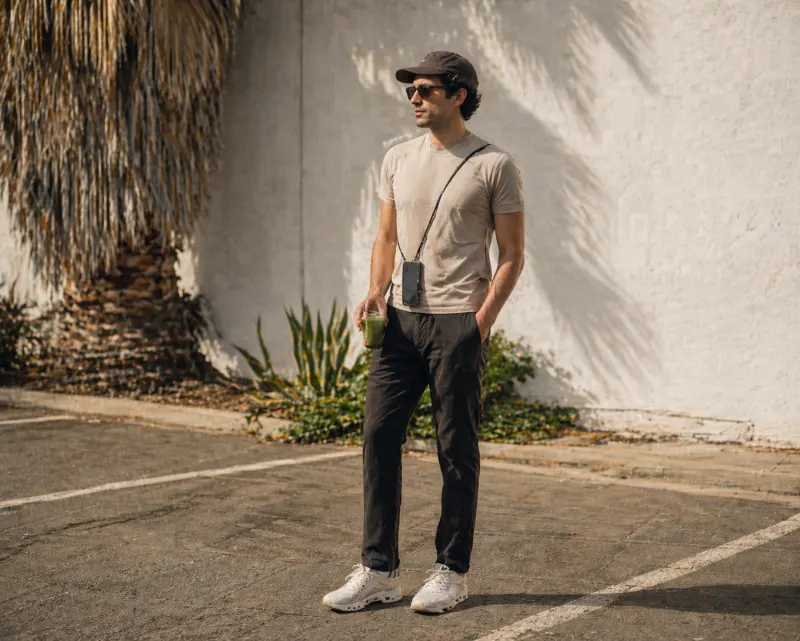
The uniform of the 9am Pilates class that costs more than dinner.
Name: Descriptive. Our label — “athleisure” is the canonical term for the broader category (coined in the mid-2010s fashion press), but the specific LA / wellness inflection does not have a fixed name.
Context: Wellness industry, entertainment-adjacent professionals, and affluent urban women and men who treat exercise as a daily routine · Los Angeles, Austin, Miami (in lesser form), Scottsdale · 2010s to present.
The combination: Lululemon ABC trousers or Align leggings, a fitted Vuori or Alo Yoga top, a technical zip-up or a cropped hoodie; On Cloud or Hoka running shoes in a tonal colourway; a cap from a gym, a retreat, or a wellness brand; a matcha or a green juice in hand. For women, the same category with a sports bra visible under an oversized tee, matching-set leggings and crop, a Bala Bangle. Sunglasses and a long phone-case lanyard. For men, the same top half with the ABC pant, which is cut to look like a chino but performs like activewear.
The register formed around a specific Los Angeles infrastructure: boutique fitness (SoulCycle, Barry’s, Equinox, Erewhon-culture Pilates and yoga studios), a warm dry climate that supports dressing-for-exercise as dressing-for-life, and a wellness economy that turned daily movement into a social and class-signalling activity. Lululemon as a brand scaled in the 2010s on this culture specifically; Vuori, founded in 2015 in Encinitas, captured the men’s side.
What it signals inside: wellness literacy, disposable income (the ABC pant retails around $130, the Align legging around $100, and the uniform assumes multiples), and a specific Californian relationship to the body. Outside, especially in New York or in European cities, it reads as under-dressed for anything but the gym. In LA, workout clothing is daywear.
References: The New York Times Style section on Lululemon and the athleisure economy; Business of Fashion on Vuori and Alo Yoga; The Atlantic and The Cut on Erewhon and LA wellness culture; brand histories of Lululemon (founded Vancouver, 1998, scaled through the 2010s) and Vuori (2015).
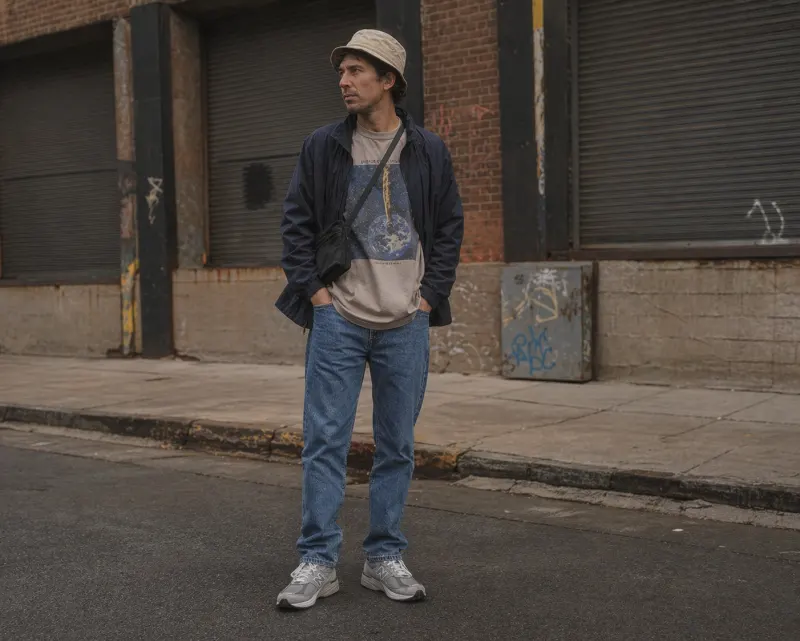
The uniform that looks like your dad in 1996, on purpose.
Name: Attested. “Dad shoes” and “dadcore” circulated in fashion writing from roughly 2017 onward — Highsnobiety, GQ, Hypebeast, and The Cut all used the term. “Normcore” (coined by the trend-forecasting collective K-Hole in 2013) named an adjacent register; dadcore is the more specifically paternal, slightly later inflection.
Context: Urban men, roughly 25 to 40, often with creative or tech-adjacent jobs · New York, Los Angeles, London, Berlin, Tokyo · late 2010s to present.
The combination: chunky retro running shoes — New Balance 990s (especially made-in-USA versions), Asics Gel-Kayano 14, Saucony Shadow 6000, New Balance 2002R — worn with mid-blue dad jeans or loose khakis; an oversized graphic tee from an obscure 1990s event or a plain heavyweight crewneck; a quarter-zip fleece or a zip-up windbreaker that could plausibly have been bought at a hardware store in 1998; a bucket hat or a five-panel cap; a small crossbody bag or a fanny pack worn across the chest.
The register emerged from several directions at once. The New Balance 990 had been a quiet signal of taste among menswear writers and Japanese archivists for years; Ametora (W. David Marx, 2015) documented the Japanese fascination with American workwear and sportswear which seeded much of it. Balenciaga’s Triple S (2017) brought the chunky-trainer silhouette into luxury fashion, and the wider culture followed. The self-awareness is key: the clothes explicitly reference the kind of unremarkable suburban-American man’s wardrobe their wearers’ actual fathers wore in the 1990s, repurposed as a knowing aesthetic rather than an unconscious one.
What it signals inside: fluency in a specific corner of menswear discourse, a post-hype stance (the opposite of visible streetwear branding), and a comfort with looking slightly dorky on purpose. Outside, it reads as a dad.
References: W. David Marx, Ametora: How Japan Saved American Style (2015); Derek Guy at Die, Workwear! on New Balance and the economics of dad shoes; Highsnobiety, Hypebeast, and GQ on dadcore and the New Balance 990 lineage; The Cut and The New York Times on normcore and its successors; K-Hole, Youth Mode: A Report on Freedom (2013), on normcore as context.
Many more informal uniforms exist and will accrete entries as the documentary record fills in — rugby and prep-school alumni dress (Barbour-ish with a school tie and a battered holdall), the Eastern European IT specialist (fitted technical jacket, dark jeans, minimal logos, functional watch), the Parisian bobo (bourgeois-bohemian: unstructured tailoring, scuffed leather, deliberately imperfect hair), the Tokyo archivist (American workwear worn with obsessive correctness), and regional variants of most of the above. Entries will be added as patterns crystallise enough to describe, whether through external documentation or their own accretion over time.