 LAPEL The Style LAPEL The Style
 A dress code is a rule handed to you — on an invitation, in a company handbook, at the door of a courtroom or a club. You do not choose it. The code specifies what is acceptable for a given occasion, setting, or role, and the consequence of ignoring it ranges from a polite correction to being turned away.
Codes vary in how tightly they are written. Some are codified to the stitch — military dress regulations, the court dress of barristers, the white-tie wardrobe of a state banquet. Some live in etiquette handbooks (Debrett’s, Emily Post) with enough precision to settle an argument. Some are written into company policy but vary between firms. And some — smart casual most of all — exist only as social convention and get argued about every time they appear on an invitation.
Codes run, conventionally, from most to least formal. What follows is the hierarchy in current use, with the occasions where each appears and the references that document it.
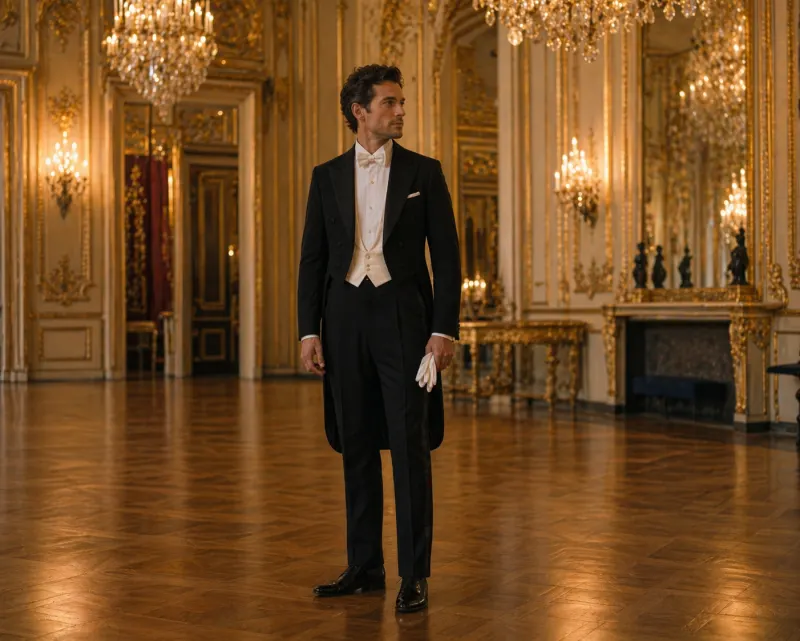
Full evening dress. The most formal code still in regular use.
The garments are fixed. A black tailcoat cut so the front points sit at the natural waist while the tails fall behind the knee; a white piqué waistcoat in the low U-shape, cut to sit above the coat’s front opening and never visible below it; a white piqué bow tie, self-tied; a stiff-fronted dress shirt with detachable wing collar and piqué bib; black dress trousers with two rows of satin or braid down the outseam; patent-leather Oxfords or opera pumps with a grosgrain bow; black silk socks; white kid gloves, historically worn for dancing; decorations — medals, stars, sashes — where the wearer is entitled to them.
The tailcoat descends from 18th-century riding dress, where the fronts were cut away to sit cleanly over a saddle. Through the 19th century it migrated indoors and became evening wear, and by the 1880s the full white-tie kit had settled into roughly its current form. The 1930s — the Duke of Windsor era — saw the last meaningful refinements, chiefly in cloth weight and the midnight-blue alternative that reads blacker than black under incandescent light.
Occasions today are narrow. State banquets at Buckingham Palace and foreign equivalents; certain livery-company dinners in the City of London; the Nobel Prize banquet in Stockholm (where Swedish protocol enforces the code more rigidly than most British hosts now do); the Vienna Opera Ball; a handful of university balls and hunt balls; senior diplomatic receptions. In Scandinavia white tie retains genuine social currency — Swedish academics wear it to doctoral conferrals — whereas in the UK and US it survives mainly as ceremonial costume. Common failures cluster at the edges: a turndown collar instead of the wing; a black waistcoat borrowed from black tie; a long tie; a dinner jacket with a white bow tie, which reads as a costume rather than a code.
References: Wikipedia; Debrett’s A–Z of Modern Manners; Hardy Amies, ABC of Men’s Fashion (1964); G. Bruce Boyer, True Style (2015); Nicholas Storey, History of Men’s Fashion (2008).
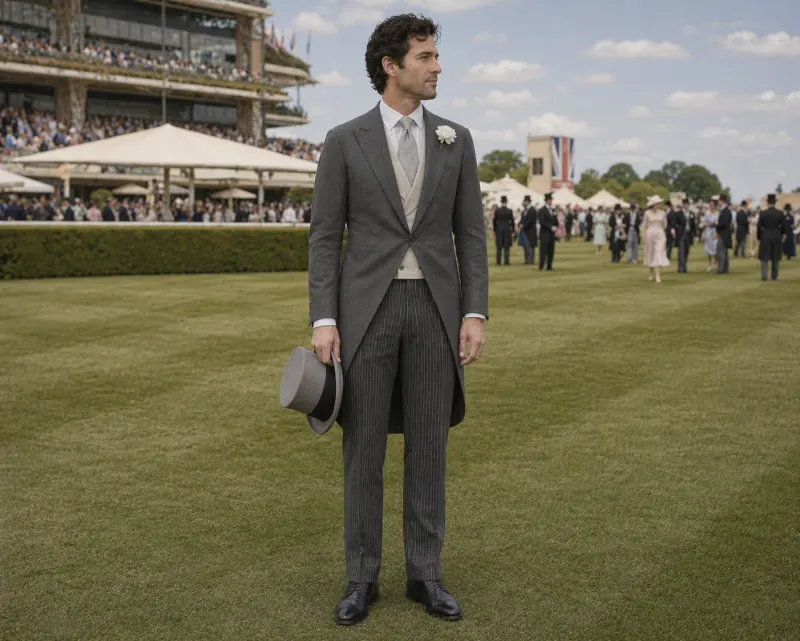
The daytime equivalent at the top of the pyramid.
A morning coat in black or Oxford grey, single-breasted with a single button at the waist and curved fronts sweeping back into tails; a waistcoat in buff, dove grey, or pale blue, single- or double-breasted; formal trousers in grey-and-black cashmere stripe or houndstooth check, never matching the coat; a white shirt with a stiff turndown or wing collar; a woven silk tie or, at the formal end, a cravat secured with a pin; black calf Oxfords, not patent; a silk top hat, grey or black, optional but expected at Ascot. A boutonnière — carnation or rose — is the usual flourish.
Like the tailcoat, the morning coat began as riding dress and moved indoors over the course of the 19th century. By the 1920s, following Edwardian codification, it had settled as the daytime formal uniform for weddings, court levées, and the racecourse. Ascot’s Royal Enclosure publishes its rules each season and polices them at the gate, which has preserved the code where social convention alone would have eroded it.
In current use the code is almost entirely British or Commonwealth: Royal Ascot’s Royal Enclosure, senior weddings in the UK — including, by convention, most royal weddings — investitures, Garter Day, and papal audiences for heads of state. Americans encounter it rarely, and often get it wrong when they do: a black three-piece suit stood in for the morning coat through much of the 20th century at US society weddings, and the mistake persists. Common failures elsewhere include matching trouser to coat (which reduces the outfit to an oddly cut black suit), patent shoes carried over from evening wear, and the four-in-hand tied too short.
References: Wikipedia; Debrett’s; Royal Ascot’s published Royal Enclosure dress code (issued annually); Boyer, True Style (2015); Storey, History of Men’s Fashion (2008).
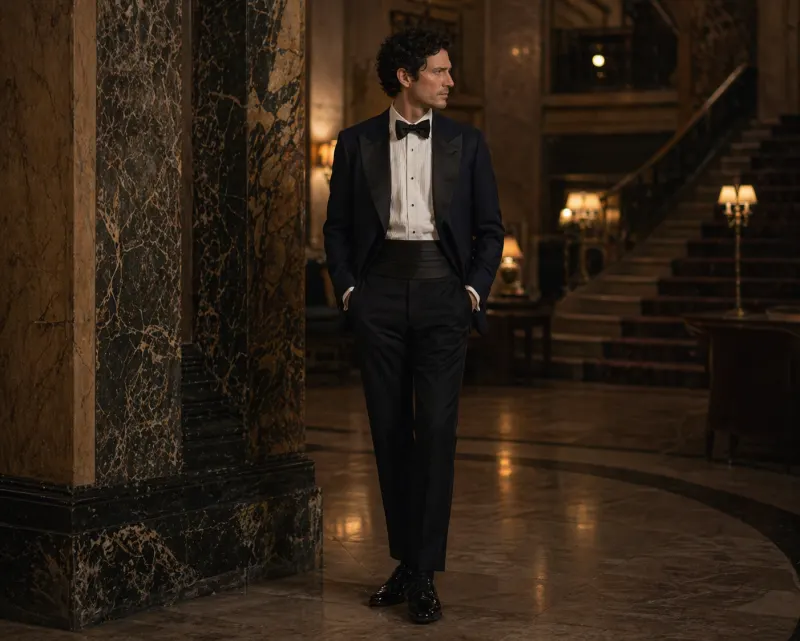
The working formal-evening code since roughly 1888.
A dinner jacket in black or midnight-blue worsted or barathea, single- or double-breasted, with peak lapels or a shawl collar faced in silk — satin or grosgrain — and never notch; a black silk bow tie, self-tied, matching the lapel facing; a white dress shirt with a turndown collar and either a pleated front or a piqué bib; black dress trousers with a single row of silk braid down the outseam; patent-leather Oxfords or opera pumps; black silk socks reaching the calf; a black silk cummerbund worn pleats-up or a low-cut evening waistcoat. No brown in any component, no coloured shirt, no long tie, no notch lapel.
The dinner jacket’s origin story is well documented, though contested at the edges. In 1886 a tailless evening coat appeared at the Tuxedo Park club’s Autumn Ball in New York. The traditional account credits a young member, Griswold Lorillard — though contemporary press suggests he wore something closer to a scarlet mess jacket, and fashion historians more often credit the banker James Brown Potter, a fellow member who had visited the future Edward VII that year and been referred to his tailor, Henry Poole of Savile Row. The same house had made Edward a short smoking jacket in 1865 for informal dinners at Sandringham. Whatever the exact genealogy, the name “tuxedo” stuck in America, and the coat spread through the Anglosphere as the less formal alternative to white tie. The midnight-blue variation was popularised by Edward VIII in the 1930s, on the “blacker than black” reasoning that made it the tailor’s preference for serious evening wear.
Contemporary use is wide and uneven. In the US, black tie covers weddings, galas, opera openings, awards ceremonies, and a long tail of charity dinners; Hollywood award shows are loose with the code and frequently mix in creative black tie (see below). European galas tend to enforce more strictly — the Opéra Garnier and La Scala season openings, Vienna’s Philharmoniker Ball, Monaco’s Red Cross Ball. Weddings specifying “cravate noire”, “evening dress”, or simply “black tie” all mean the same kit. The most common failures, in roughly descending order of frequency: notch lapels (a business-suit cut sold as a tuxedo); a long black tie; a wing-collar shirt (white-tie territory, not black); brown shoes; a coloured cummerbund chosen to match a partner’s dress.
References: Wikipedia; Debrett’s; Alan Flusser, Dressing the Man (2002); the Black Tie Guide; Boyer, True Style (2015).
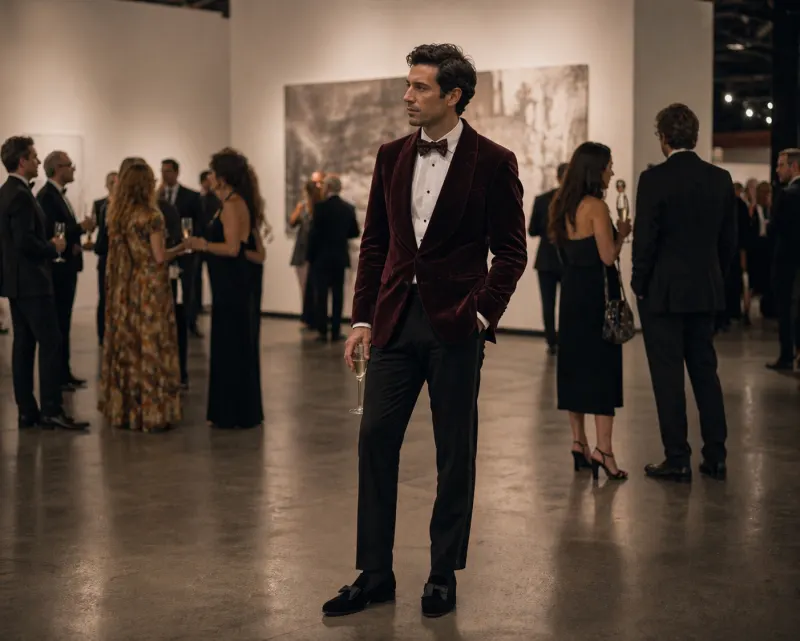
Black tie with licensed deviations.
Creative black tie treats the dinner-jacket kit as a frame rather than a rule. Inside it, the host invites deviation: a jacket in midnight velvet, burgundy silk, a tartan or a brocade; a bow tie in a colour or patterned cloth; velvet slippers or black suede loafers in place of patent Oxfords; a patterned cummerbund; on bolder occasions, a coloured evening shirt or an open-necked dress shirt with a silk scarf. The rest of the architecture — black trousers with braid, a formal shirt, studs and links, the general silhouette of black tie — is meant to hold.
The phrase is American and late-20th-century, rooted in Hollywood and gallery-fundraiser culture where guests competed to look interesting on step-and-repeats. “Black tie optional” is a separate softening with different intent: the host is signalling that a well-cut dark suit will not cause offence, while making clear that a dinner jacket is still preferred. In practice “optional” is weaker than it sounds — roughly half the room will be in black tie and the suit-wearer will read as slightly underdressed.
Occasions are where the invitation originates: gallery galas, museum benefit dinners, fashion-week events, film-industry awards, creative-industry anniversaries, certain destination weddings. The failure mode is misreading a plain “black tie” invitation as a licence for creativity; if the host has not written “creative”, do not improvise.
References: no canonical documentation; covered in passing by Flusser, Dressing the Man (2002) and the Black Tie Guide. The Gentleman’s Gazette tracks variant interpretations.
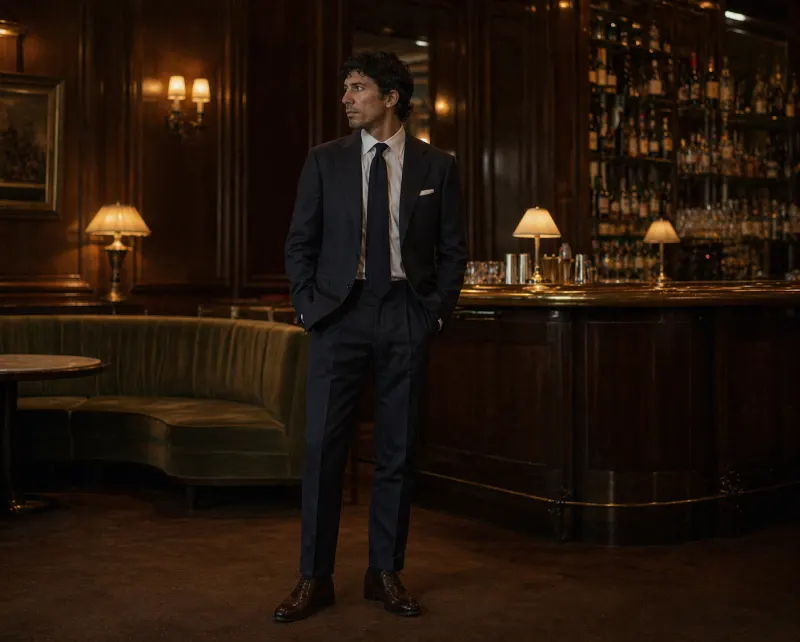
Between black tie and business.
A dark two-piece suit in navy or charcoal worsted; a white or pale-blue shirt with a turndown collar; a sober silk tie in a solid, grenadine, or small-figured pattern; dark leather Oxfords or Derbys, black or dark burgundy; plain socks in the trouser colour; a pocket square if the occasion runs dressier. A three-piece suit or a double-breasted jacket reads appropriately up-weighted for evening. The register sits cleanly between black tie and a working business suit — the “dark suit” that European etiquette handbooks have referred to since the interwar period.
“Cocktail attire” as a named code entered the etiquette vocabulary in the US in the 1920s and 1930s, alongside the rise of the cocktail party itself — a home-entertainment format pitched between afternoon tea and the formal dinner. Emily Post’s editions from the 1940s onward codified what to wear to them, and by mid-century it had spread as the default for private evening functions below the dinner-jacket threshold. Today the code covers a wide band of evening events and is interpreted loosely on both sides of the Atlantic.
Occasions: evening weddings marked “cocktail” on the invitation, charity auctions, formal restaurants that require a jacket, embassy receptions below state-banquet level, pre-theatre dinners, private-view openings. Common failures are directional rather than technical: a light-grey suit reads too daytime for an evening invitation; a business suit with a patterned shirt and no tie reads too casual; black suits, historically funereal in British convention, still feel off to older European hosts even as they have normalised in US urban dressing.
References: Wikipedia; Emily Post’s Etiquette, 20th edition (2022); Debrett’s; Flusser, Dressing the Man (2002).
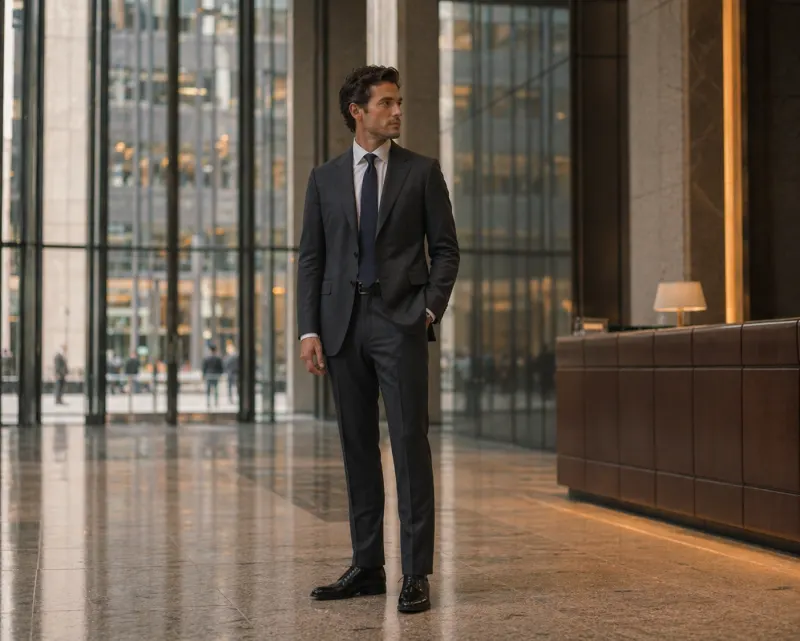
The corporate default for client-facing work.
A matched two-piece suit in a sober worsted — navy, charcoal, or mid-grey — cut cleanly to the body without fashion-forward exaggeration; a white or pale-blue cotton shirt with a turndown collar; a silk tie in a solid, grenadine, stripe, or small geometric; dark leather Oxfords (the closed-lacing construction is the formal signal, with Derbys acceptable in the less rigid end of the code); over-the-calf socks in the trouser colour; a belt matched to the shoes. Three-piece variants are legitimate and read slightly more formal. In historically conservative industries — City of London law firms, investment banks, senior diplomacy, the judiciary — the palette narrows further: black or very dark charcoal suit, white shirt, dark tie, black Oxfords, with brown footwear historically refused under the old “no brown in town” convention that still lingers in some chambers.
Business formal is the direct descendant of the lounge suit that settled as daytime dress for professional men over the last quarter of the 19th century. The post-war decades tightened it into a near-uniform; the 1980s Wall Street and City boom codified its most conservative version; the 1990s-onwards business-casual wave pushed it back into a smaller set of client-facing and court-facing contexts. The uniform has survived inside those contexts precisely because the code carries information — a defendant’s counsel or a merger adviser wearing anything softer reads as not taking the room seriously.
Occasions: courtrooms on both sides of the bar; investment-banking and private-equity client meetings; traditional law firms; senior civil service and diplomatic functions; some embassy daytime events. Failures are mostly small: a shirt cuff that does not show beyond the jacket sleeve; a tie knot oversized or untidy; brown shoes worn into a context where the older rule still applies; a shirt pattern loud enough to compete with the tie.
References: Boyer, True Style (2015); Flusser, Dressing the Man (2002); Amies, ABC of Men’s Fashion (1964); firm and chambers dress handbooks (private, variable); Debrett’s guidance on “business dress” and “lounge suit.”

The office-floor code since the 1990s.
A jacket or blazer — often unstructured, often in a soft cloth such as cotton, fresnaye, or a summer wool — worn with odd trousers or chinos rather than a matched suit; a collared shirt, usually without a tie; leather shoes ranging from loafers and Derbys down to clean, dark minimalist sneakers in the softer offices. Knitwear substitutes freely — a fine-gauge merino or cashmere crewneck over a shirt reads business-casual in most European offices. What separates it from smart casual is the expectation of a collar and tailored trousers; what separates it from business formal is the absence of a matched suit and tie.
The code’s spread is traceable. In the early 1990s, Levi Strauss’s Dockers brand ran a campaign — distributing a “Guide to Casual Businesswear” pamphlet to American HR departments in 1992 — explicitly selling chinos as the right answer to the emerging “casual Friday” question. The pamphlet and its follow-on marketing were widely covered at the time and are credited in retrospect with accelerating the transition from suit-and-tie to the softer register. Tech companies pushed it further through the late 1990s and 2000s, and by the 2010s business casual — rather than business formal — had become the default office-floor code across much of the white-collar world.
Contemporary use varies sharply by geography. In the US it has drifted downwards toward the jeans-and-polo end; in continental Europe — Milan, Paris, Zurich, Frankfurt — it retains more tailoring, with an unstructured jacket and loafers still the weekday default in many offices. Japanese corporate culture stayed closer to business formal for longer but has loosened in the post-pandemic years. Common failures are reading it as “any clothes that aren’t a suit” — trainers with a ripped hem, an untucked shirt worn open-necked over a T-shirt, combat trousers — rather than as a genuine step down in formality that still expects tailoring.
References: Wikipedia; contemporary press coverage of the Dockers “Guide to Casual Businesswear” campaign (1992); Boyer, True Style (2015); company handbooks (common but variable).
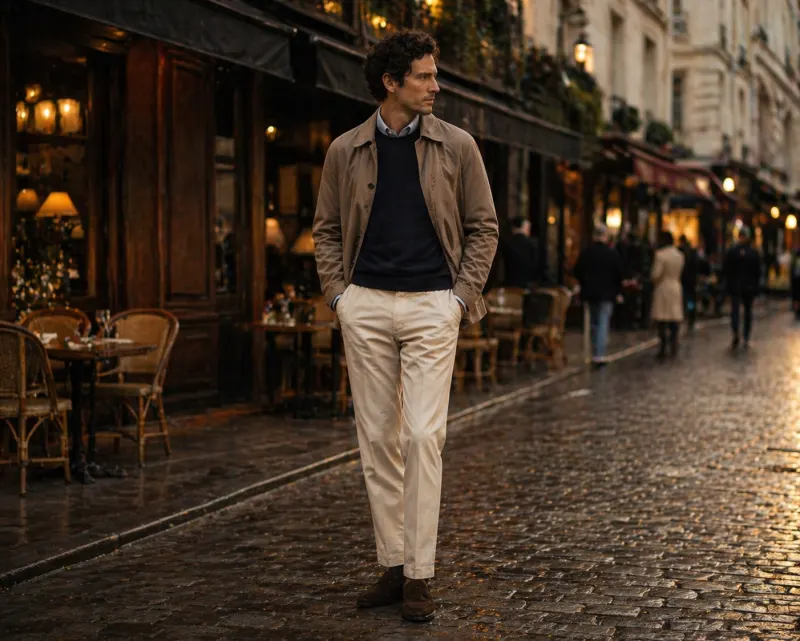
The space between suits and weekend clothes.
Ambiguous by design. In practice the code asks for an outfit that looks considered without the formality of a suit — an unstructured jacket, overshirt, or tailored knitwear layer on top; clean trousers, chinos, or dark well-cut denim below; leather shoes, loafers, or minimal sneakers; a collared shirt or a smart knit rather than a printed T-shirt. Arguments start at every edge. Is a blazer required, or will a fine-gauge merino crewneck do? Are dark jeans acceptable, or does it need chinos? Is a polo smart enough? Can white sneakers ever be right? Each host will have their own answer.
The term gained traction in British usage from the 1980s onwards, as the old “jacket required” conventions at restaurants and clubs began softening and the space between business dress and weekend clothes widened. It is a code of the post-industrial service economy — a way of signalling that the wearer takes the occasion seriously without claiming a formality the setting does not warrant. Unlike black tie, it has no canonical reference; unlike business casual, it has no HR-department origin story; it accreted from convention and argument, which is why it keeps moving.
Occasions: most modern dinners out, invitations marked “smart casual”, restaurants with loose but non-zero standards, gallery openings at the softer end, Friday-evening offices, dates, travel days when the next stop is a decent hotel. Regional readings diverge: London reads smart casual dressier than New York; Italian cities dressier than either; Berlin and Los Angeles looser still. The common failure is the binary reading — either defaulting to a full suit and overdressing, or defaulting to a T-shirt-and-jeans and underdressing — when the code is asking precisely for the space between.
References: Wikipedia; no single authoritative etiquette source; Smart casual covers it at article length.

The non-code.
Whatever the wearer chooses, within the loosest bounds of the setting. Jeans and a shirt; chinos and a T-shirt; shorts and sandals in a warm climate; a sweatshirt and trainers. The lower floor of dress-code specifications is “we are not telling you what to wear”, and the category exists less as a positive instruction than as the absence of one.
Where “casual” does appear on an invitation or in a company handbook, it is usually doing quiet work — telling the reader that a jacket is not expected but that cleanliness, fit, and general presentability still are. A football shirt, a ripped band T-shirt, beachwear, or obvious loungewear will still read as wrong in most “casual” contexts despite the nominal permission. The code sits below smart casual on the formality ladder and above no-code-at-all only in the mild implication that the wearer has thought about it.
Not a code at all, really — the absence of one, gently marked.
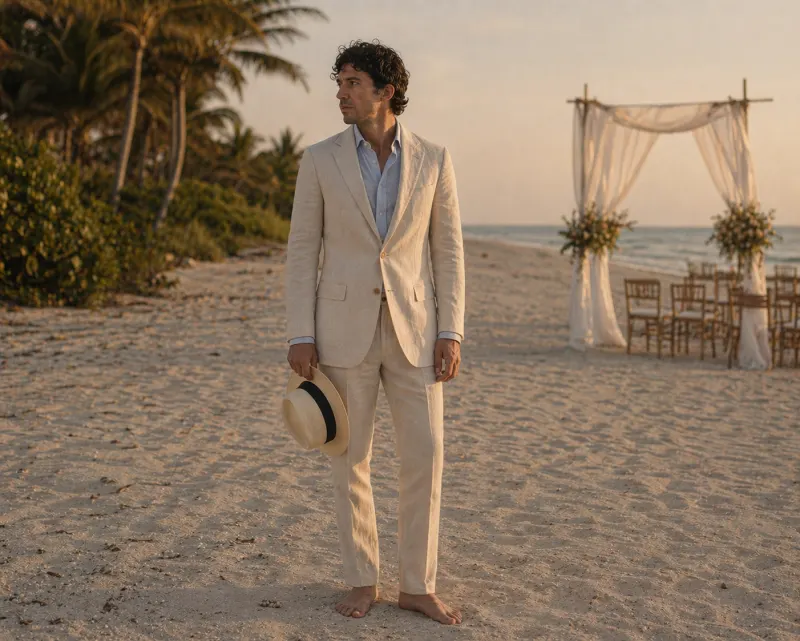
Tied to setting rather than a rung on the formality ladder.
Several codes attach to a place or activity rather than a rung on the main ladder. Each carries its own expectations, shaped by venue, climate, and the event’s informal history.
Beach formal. An evening code for destination weddings and seaside galas: a lightweight suit or blazer in linen, tropical wool, or cotton — white, cream, sand, or pale blue — worn with an open-collared shirt, no tie, and either leather loafers or, at the loosest end, the host’s explicit invitation to go barefoot on sand. Panama or straw hats are common daytime additions.
Resort casual. Daytime holiday dress at hotels, yacht clubs, and warm-weather resorts. Pressed cotton or linen trousers or well-cut shorts; a polo, linen shirt, or short-sleeved button-up worn untucked; boat shoes, espadrilles, or loafers without socks. The distinction from generic “casual” is that the clothes are finished and coordinated rather than thrown on.
Country casual. British countryside and country-house dressing: tweed jackets in estate or heather checks, moleskin or cord trousers, checked shirts, knitted ties or no tie, sturdy brogues or Wellingtons in wet weather, a waxed cotton jacket (Barbour and its peers) as outerwear. Shooting weekends codify this most tightly; weekend visits to a country house loosen it.
Garden party. A daytime summer code, most rigid at Buckingham Palace garden parties and their equivalents: a lightweight morning suit or a lounge suit with a tie; for women, day dress with hat. At softer garden parties — private receptions, summer weddings on a lawn — a mid-grey or blue lounge suit with a sober tie and lightweight leather shoes is the working interpretation.
Tenue de ville. The French phrase (“town dress”) that appears on Continental invitations where British hosts would write “lounge suit” and American hosts “business attire.” It means, roughly, a mid-weight suit in a sober colour with a shirt and tie — the standard daytime working outfit of a European city.
Other codes in the same family appear on narrower invitations: black-tie variants specific to academic regalia, messes, and ship’s dinners; “dress uniform” as an explicit option for serving officers and diplomats; hunt dress for the field. Each is policed by the organising body and written into its own house rules.
References: Wikipedia for the overarching hierarchy; Debrett’s; Emily Post, Etiquette (20th ed., 2022); event-specific written guidance (Royal Ascot, Glyndebourne, individual venues and estates).
A dress code tells you what to wear. It does not tell you what style you are wearing. A navy suit with a sober tie can be business formal (in a law firm) or cocktail (at a restaurant dinner) — same garments, different codes. A grey T-shirt and clean jeans can be appropriate (at a start-up office) or inappropriate (at a gala) — same outfit, different settings. The code and the style are independent axes, which is why Styles today treats the styles as a separate space.
And codes do not exhaust what people actually wear. Outside any codified context, a third category operates — the informal uniforms that accumulate inside professions and subcultures. Those are covered in Informal uniforms.