 LAPEL The Style LAPEL The Style
 Named styles are usually discussed as a single line from formal to casual. That line exists, but it flattens too much. Two outfits can sit at the same point of formality and look nothing alike, because they differ on a second axis — loud vs quiet, classic vs contemporary, tailored vs relaxed, or the tradition they borrow from. Style is a space, not a ladder. This page maps the space, then places the modern styles inside it.
Five axes do most of the descriptive work. Every named style below is a coordinate — an approximate position on each of these.
Black tie at one end, gym clothes at the other. This is the axis everyone knows and the one that usually determines whether an outfit is appropriate for an occasion. Most adult life happens in the middle third: business casual, smart casual, casual.
Loud vs quiet. How much visual noise the outfit makes — through colour saturation, pattern, silhouette presence, and visible branding. A quiet outfit recedes; a loud one is the first thing you notice about the wearer. Streetwear is loud by design; quiet luxury is quiet by design. Both can be expensive.
Classic vs contemporary. Does the outfit reference an established tradition (1950s Ivy, 1960s Neapolitan tailoring, 1970s workwear) or the current moment (gorpcore, techwear, the last five years of sneaker design)? Classic styles age slowly; contemporary ones age visibly.
Tailored and fitted vs relaxed and oversized. This is mostly independent of formality — streetwear can be oversized, tailoring can be drapey, a suit can be cut close or full. Silhouette is the first thing read from across the street, before colour or garment.
The tradition the style pulls from: tailoring, workwear, sportswear, military, prep, or street. Most modern styles are hybrids — smart casual borrows from tailoring and sportswear; gorpcore borrows from outdoor-tech and street. Knowing the origin explains why certain garments belong and others don’t.
There is no canonical list of styles. Fashion histories, menswear publications, tailoring houses, and subculture archives all draw different lines, and two specialists given the same outfit will often disagree on what to call it — is “quiet luxury” a style, a filter on classic sartorial, or marketing language? The answer depends on how finely you’re willing to split.
Push the splitting far enough and you get hundreds of named styles: every subculture, regional tradition, designer house, and seasonal revival has its own label somewhere. Nobody owns or polices the vocabulary. This is why fashion writing mixes dress codes, subcultures, aesthetic philosophies, and trend names in a single list without flagging the category difference — that is how the terms circulate in practice.
The seventeen entries below are what most of adult urban menswear looks like in 2026 — the styles a reader is likely to encounter, wear, or want to depart from. The selection bar is diagnostic usefulness: each coordinate is distinguishable from its neighbours on at least one axis, and each carries enough recognition that naming it communicates something. Smaller niches (techwear proper, regional Ivy revivals, archival reproduction) are collapsed into nearby entries.
For readers who want to go deeper: G. Bruce Boyer’s True Style (2015) for the classic-tailoring lineage; W. David Marx’s Ametora (2015) for the American-to-Japanese workwear and Ivy crossover; the Take Ivy photo book (1965, reissued 2010) for the preppy canon; Derek Guy’s writing at Die, Workwear! and Simon Crompton’s Permanent Style for continuous commentary; Hypebeast and Highsnobiety for streetwear coverage.
Each entry below gives the coordinate first, then the character. The coordinates are approximate — styles have internal range, and a given outfit can sit further up or down an axis than the style’s centre of mass. Entries are grouped loosely by formality for readability; the other four axes (statement, era, silhouette, origin) do the real differentiation, and two styles at the same formality can sit far apart elsewhere on the map.
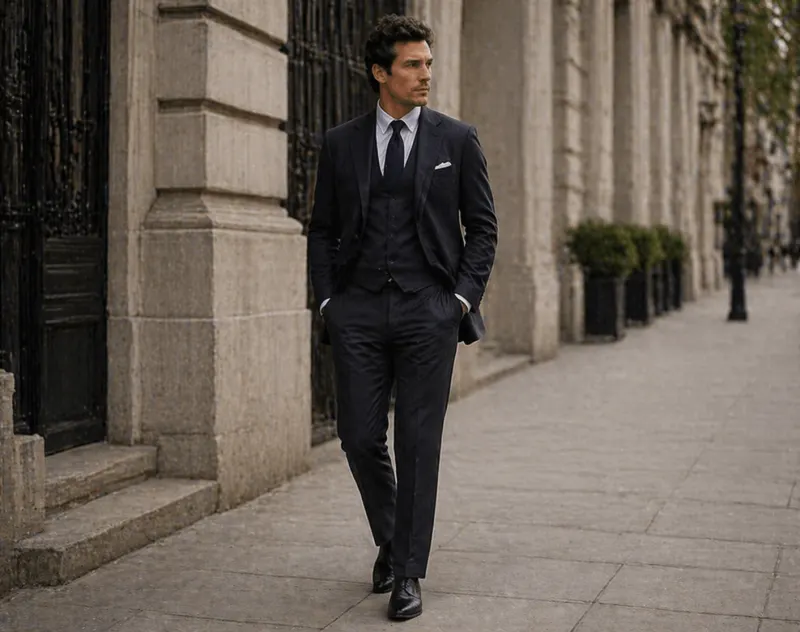
The uniform of institutions.
Two- or three-piece suit in dark worsted wool — charcoal, navy, occasionally black — worn with a white or pale shirt, a sober tie, and black Oxford shoes. The dress code of law firms, investment banking, senior government, and the interior of a formal wedding. Designed to subtract the wearer from the picture so the role stands in front.
As a codified office uniform, business formal crystallised in the post-war 1950s and held stable for half a century. Its language is institutional: the deep V of the jacket frames a clean unfussy torso, the tie is a vertical line, nothing visible is doing anything other than load-bearing work. Tailoring houses from Savile Row down to the American Ivy-derived traditions dress this register by default, as do continental makers once they formalise.
A business formal outfit fails by drawing attention. A patterned shirt, a saturated tie, a brown shoe, a contrasting belt — any single visible variation from the norm turns the wearer from role-occupier into individual, at a moment where individuality is the wrong signal. The code is unforgiving because it is supposed to be; softening it is what the adjacent codes (classic sartorial, business casual) are for.
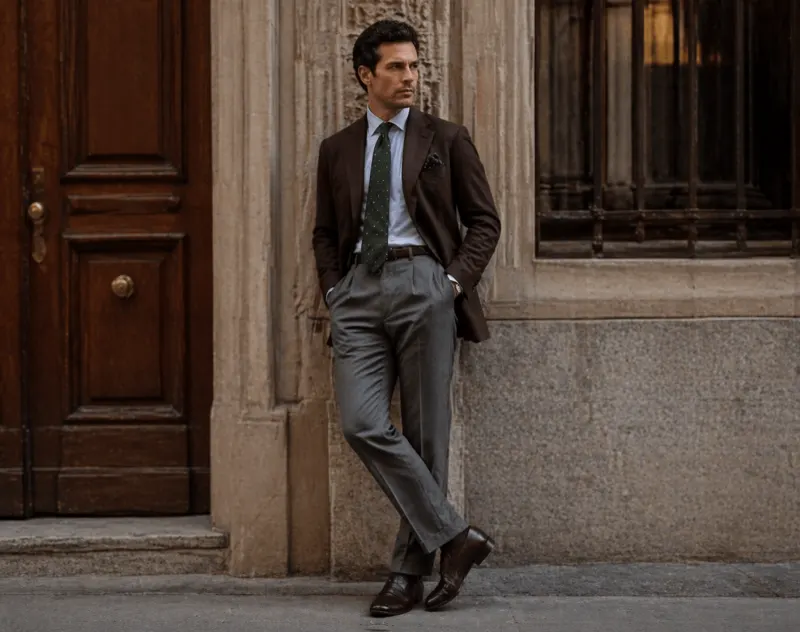
Tailoring worn by choice, not by obligation.
Soft-shouldered jackets in odd cloth — tweed, flannel, hopsack — paired with contrasting trousers, a shirt that may or may not carry a tie, and leather shoes chosen for patina rather than shine. The register borrows freely from the two great tailoring traditions: the structured English line out of Savile Row, and the softer Neapolitan line associated with houses like Rubinacci and Attolini. It reads as considered rather than corporate.
The modern sartorial revival is roughly a post-2000 phenomenon, carried by menswear blogs and magazines re-teaching a vocabulary the mass market had forgotten through the casualwear decades. G. Bruce Boyer’s True Style (2015) and Alan Flusser’s earlier Dressing the Man (2002) sit on the reference shelf; Simon Crompton’s Permanent Style and the A Suitable Wardrobe archive did the week-to-week instruction. The canonical figures it cites are mid-century — Fred Astaire, Gianni Agnelli, the Duke of Windsor — but the wearers are mostly men who picked up the language deliberately as adults.
Classic sartorial differs from business formal in intent: the suit is optional, the jacket is the unit, and the outfit is assembled rather than issued. It fails when it tips into costume — matched pocket square and tie, too-shiny shoes, a hat worn indoors — or when the cloth does the talking instead of the cut. Its quiet neighbours are business casual (less deliberate, more institutional) and soft tailoring (same grammar, looser structure).
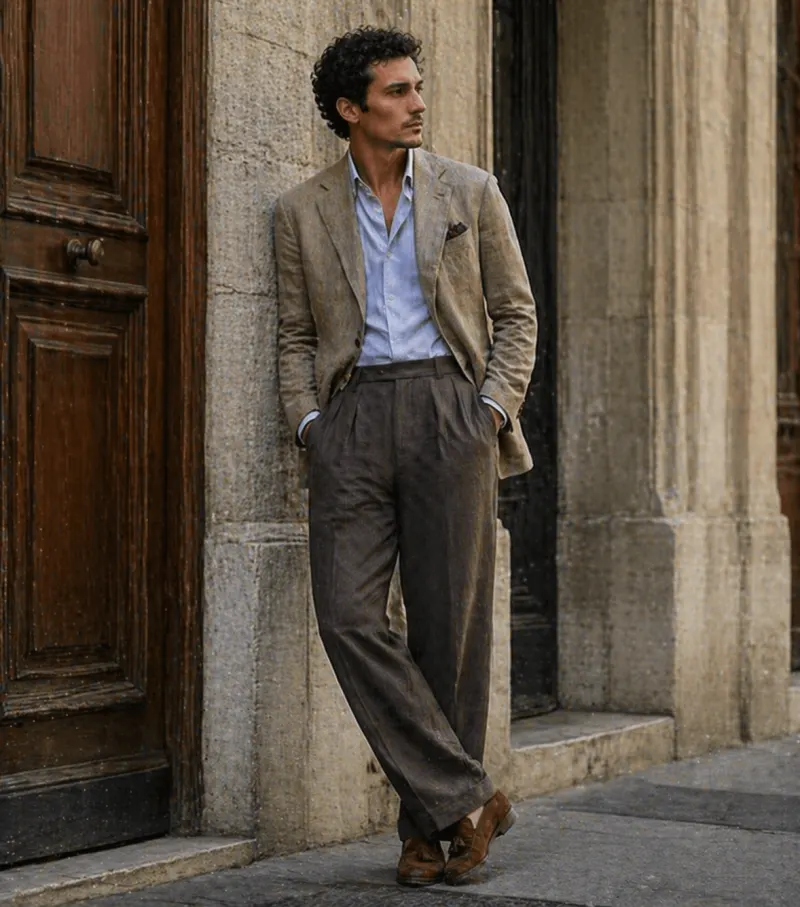
The jacket stays, the stiffness goes.
Unstructured jackets in soft cloth — hopsack, linen, washed cotton, lightweight wool — worn over open-collar shirts or fine-gauge knits, with wider pleated trousers that break softly over suede loafers or minimal leather shoes. The grammar is still tailoring, but the canvas is minimal or absent, the shoulder is natural, and the trouser has reclaimed volume after two decades of slim fit. The outfit drapes rather than holds a line.
The lineage runs through Giorgio Armani’s soft-shouldered, unpadded jackets of the late 1970s and 1980s, the Neapolitan tailoring houses that never structured their jackets heavily in the first place, and the post-2020 silhouette correction after the slim-cut 2010s. Brands like The Row, Boglioli, Lardini’s Easy Wear, and the Japanese imprint Camoshita now sell the register off the peg; bespoke houses increasingly offer it as a softer option next to their structured line. It has become the default “dressed” register in a lot of contemporary menswear media.
The style sits between smart casual and classic tailoring and borrows recognition from both. It fails when the jacket loses enough structure to read as a cardigan, when the trouser volume swamps the torso, or when the palette gets away from its natural range of beiges, browns, and muted blues into something more contrasty. Its closest neighbours are smart casual (one step more casual, less committed to tailoring) and quiet luxury (same palette, more overt material signalling).
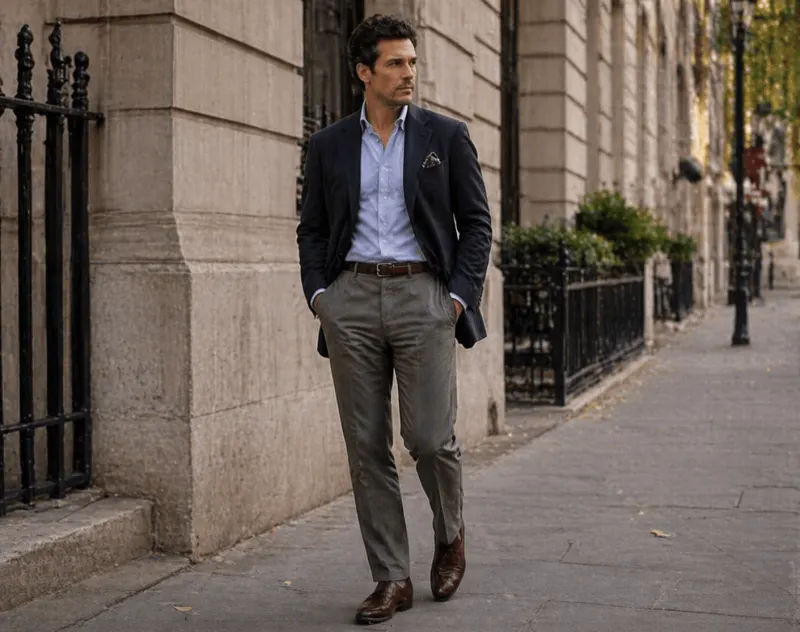
The office code once the tie came off.
Structured blazer or sport coat over a dress shirt or a neat polo, with wool or cotton trousers and leather shoes — loafers, derbies, or clean lace-ups. The palette stays conservative: navy, grey, tan, with occasional earth tones. It is tailoring minus the suit’s matched pair, minus the tie, and minus most of the ceremony — the code that offices adopted once ties stopped being mandatory but before shirts became optional.
As a codified register, business casual spread through American corporate life from roughly the 1990s onward, accelerated by Silicon Valley’s refusal to wear ties and by broader dress-code liberalisation through the 2000s. It inherits its grammar from the mid-century American business suit, softened: the blazer replaces the suit jacket, the odd trouser replaces the matched bottom. Brooks Brothers, J. Press, and the European middle-market houses (Hackett, Suitsupply) sell the look as their core product.
Business casual is conservative by design; it rewards fit and material over novelty, and its failures are familiar — an ill-fitting blazer, shiny square-toed shoes, a shirt and trouser palette that refuses to harmonise. Its formal neighbour is classic sartorial (same garments, more intent); its casual neighbour is smart casual (less structure, the jacket becomes optional rather than expected).
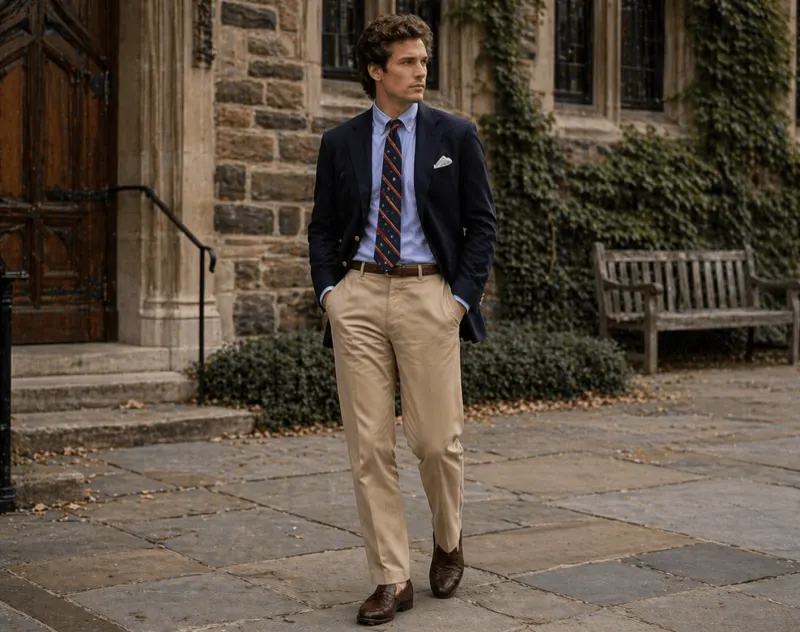
The American east-coast campus, codified and exported.
Oxford cloth button-down shirts, chinos, penny or tassel loafers, a navy blazer with gold or brass buttons, Shetland or lambswool knits, repp-stripe ties, the occasional madras or seersucker in warm weather. The colour runs higher than classic sartorial — pink shirts, green trousers, red socks are all in-register — and the fit runs looser, with a sack-cut jacket and a trouser that sits without fuss.
The look was codified on American east-coast campuses in the 1910s and 1920s, reached canonical form in the 1950s around Brooks Brothers and J. Press, and was documented for an international audience by the Japanese photographers and editors who produced Take Ivy (1965, reissued 2010). Ralph Lauren’s Polo menswear line, launched in 1968 and expanded aggressively through the 1970s, turned the campus uniform into a global aspirational style and permanently associated the register with a certain vision of American leisure. W. David Marx’s Ametora (2015) traces the round trip through Japan, where the style was preserved and refined when American taste moved on.
Preppy is louder than classic sartorial because of its colour and pattern, not its branding, and its failures come from dialling either up too far — a shirt-trouser combination that reads as costume, a logo worn large enough to carry the outfit. Its adjacent styles are classic sartorial (quieter, more formal in intent) and quiet luxury (preppy’s muted aristocratic cousin, with the colour turned down).
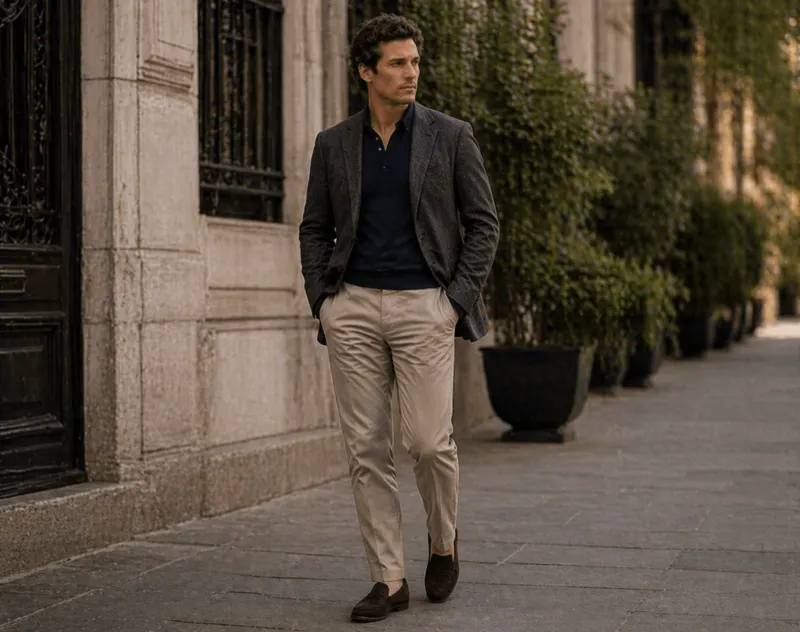
The code that covers nearly any non-ceremonial occasion.
Unstructured blazer, overshirt, or fine knit over a clean shirt or knit layer, chinos or dark denim below, finished in leather loafers or minimal sneakers. Useful because it covers almost every occasion that isn’t a ceremony; abused because the label has been borrowed by so many contradictory outfits that the phrase barely narrows anything in a dress-code line.
As a dress code, smart casual emerged in the 1990s as offices loosened out of full business attire but still wanted recognisable structure. Dockers and J. Crew rode the early wave on the American side; continental European brands like Massimo Dutti and Suitsupply carved the mid-market through the 2000s. Since roughly 2015 the register has shifted from “business casual minus the tie” toward “sartorial casual minus the formality” — the jacket remains the organising garment, but it is unstructured, and the layer under it is as often a fine-gauge knit or polo as an Oxford shirt.
Smart casual lives inside a narrow band: on one side it tips back toward business casual if the jacket structures too much or the trousers pull formal; on the other it falls into casual if the top half is a T-shirt and the bottom washed denim. The diagnostic move is the jacket — does it still read as tailoring, even relaxed tailoring? If yes, the outfit is inside the band. For the full ruleset, see smart casual.
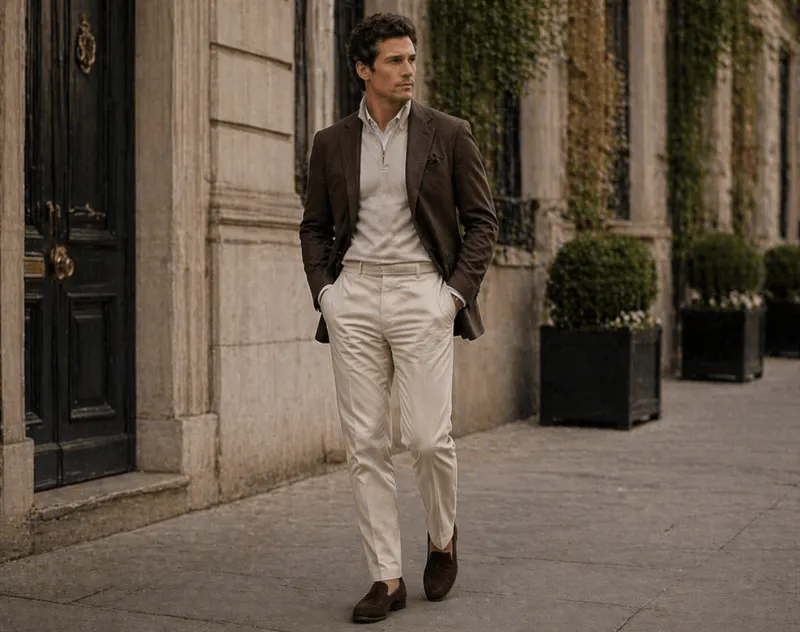
Status signalled by material, not by label.
Fine-gauge cashmere knits, soft tailoring in cream, camel, and navy, cotton or silk shirts in muted tones, suede loafers, and nothing with a visible logo. The palette is narrow — warm neutrals and washed-out colour — and the materials do the work that branding would otherwise do. The aim is to look expensive to people who already know what expensive looks like, and unremarkable to everyone else.
The aesthetic has always existed inside actual old-money wardrobes — Loro Piana, Brunello Cucinelli, Hermès, Kiton, Cifonelli — but it entered mainstream style vocabulary around 2022–2024 as a reaction to the peak of logo-forward luxury streetwear. The HBO series Succession (2018–2023) dressed its billionaire characters in the register and crystallised the term “quiet luxury” in popular menswear conversation; Gwyneth Paltrow’s understated courtroom wardrobe during her 2023 ski-collision trial added a further push. The underlying lineage, though, runs continuously through Ralph Lauren’s Purple Label, The Row (founded 2006 by the Olsens), and the established Italian cashmere houses.
Quiet luxury is more a filter applied to existing codes — classic sartorial, preppy, business casual — than a standalone style. It fails when the material signalling becomes self-conscious (too much visible cashmere, too many signifiers of wealth in one outfit) or when it reads as dressed-down to the point of shapelessness. Its neighbours are classic sartorial (more tailored, more overt) and minimalism (same restraint, without the material flex).
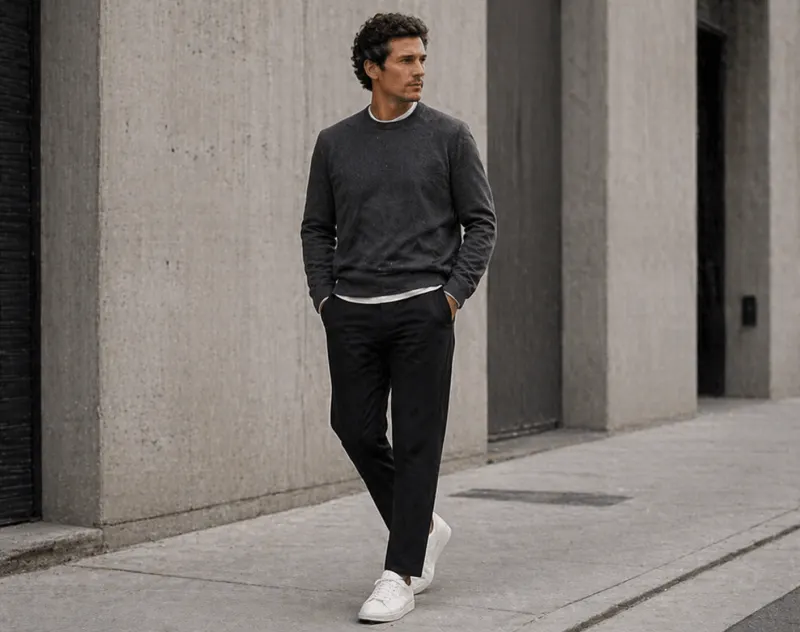
Deliberate invisibility, executed with care.
Plain garments in neutral colours — white T-shirt, grey crewneck, black trousers, white sneakers, an unadorned overshirt or coat in wool or cotton. No logos, no patterns, no contrast stitching, no hardware that announces itself. The aesthetic project is deliberate invisibility, and it depends on care about proportion, material weight, and the small geometry of hems and collars that most eyes read without registering.
Minimalism as a design language runs through Helmut Lang’s 1990s output, Jil Sander’s continuous three-decade influence, and Christophe Lemaire’s work at his own label from 2011 onward. Normcore is a different intellectual project: the term was coined by the New York trend-forecasting collective K-Hole in a 2013 report and was read (half-accidentally) as a celebration of anti-fashion — plain jeans, plain sneakers, plain caps, the refusal to signal through clothing at all. Minimalism and normcore arrive at similar outfits from opposite intentions: minimalism reduces with craft emphasis, normcore reduces by indifference.
The category fails when the restraint becomes cheapness — thin cotton, collars that curl, sneakers that yellow — because the whole register depends on the material doing the talking. Its neighbours are quiet luxury (same palette, more overt expense) and tech-minimalism (same aesthetic project, different fabric vocabulary).
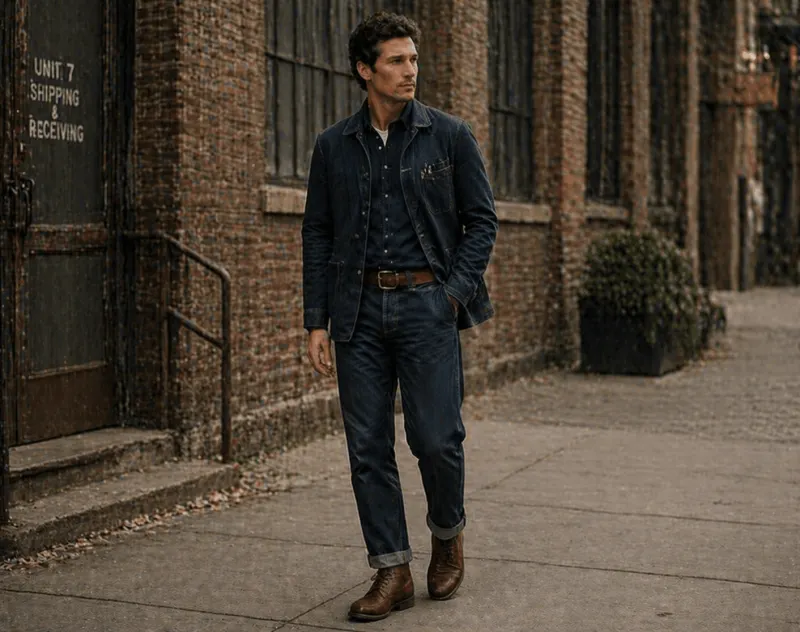
Clothes meant to age with the wearer.
Selvedge denim jeans and jackets, chore coats in indigo or brown canvas, flannel shirts, henleys, waxed cotton outerwear, leather boots — Red Wing, Alden, Tricker’s — and wool work socks. The garments are reproductions or direct descendants of early-20th-century American and European working clothes, made heavy, made to fade, and made to be repaired rather than replaced.
The revival is mostly a Japanese project: brands like The Real McCoy’s, Iron Heart, Warehouse, Sugar Cane, and Full Count spent the 1990s and 2000s reconstructing mid-century American workwear in obsessive detail, often using recovered vintage looms and the original dye recipes. On the American side the movement runs through Engineered Garments (Daiki Suzuki), RRL (Ralph Lauren’s rural-Americana line, launched 1993), and the community of small makers documented at Heddels and the Self Edge retail circuit. W. David Marx’s Ametora (2015) is the canonical account of the round trip. English workwear has its own parallel lineage through Margaret Howell, Old Town, and Barbour, with a different palette but the same commitments.
Workwear rewards patina — faded indigo, burnished leather, softened canvas — and its failures are usually the opposite: something that looks brand-new and unworn, or a piece that is too self-consciously costumey (a railroad cap, too many signifiers at once). Its neighbours are casual (same palette, less commitment to provenance) and classic sartorial in its tweedier form (more deliberate, less rugged).
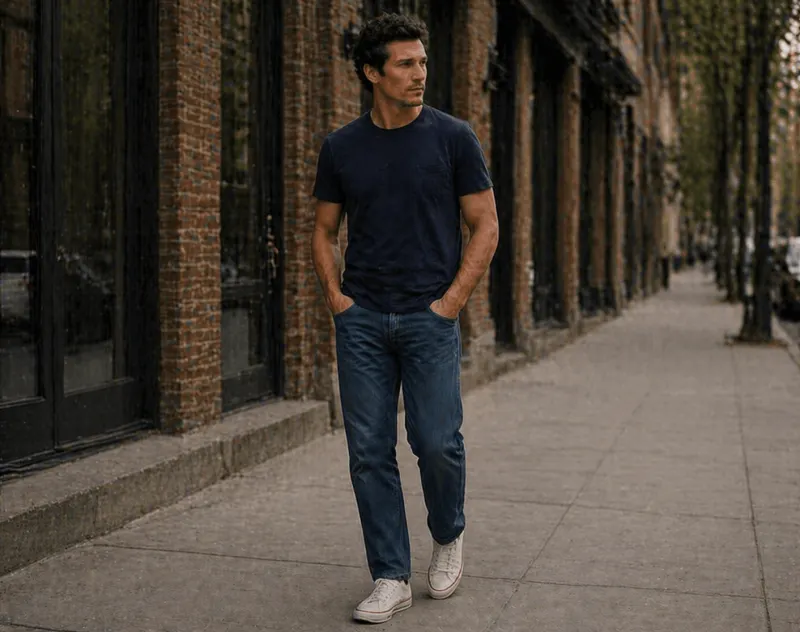
The default modern baseline.
Jeans or chinos, T-shirt or longsleeve, a knit or an overshirt for weather, low-top sneakers or plain leather shoes. No dress-code obligation, no aesthetic project, no overt subcultural affiliation. The baseline register that most adult urban wardrobes now spend the majority of their time in, and the zero-point against which everything else on this map is a deliberate departure.
Casual in its current form is a post-war phenomenon, built out of the leisurewear that followed mid-century American working wardrobes (the T-shirt’s spread from military undergarment to outerwear, the rise of blue jeans as everyday clothing, the sneaker’s move from gym to street). It has no single author — it is what is left when the dress codes above it are removed — but the garments that define it have specific lineages: the Levi’s 501 (riveted jean patented 1873, lot number assigned 1890), the Champion sweatshirt, the Converse Chuck Taylor and later the white leather sneaker.
What separates a working casual outfit from a slumped one is fit and material quality, not design. A well-cut tee in heavy cotton and dark rinsed denim reads as deliberate casual; the same silhouette in worn-out cotton with blown-out seams reads as unmade. Its quiet neighbours are smart casual (one jacket away) and street casual (the same silhouette with more subcultural commitment).
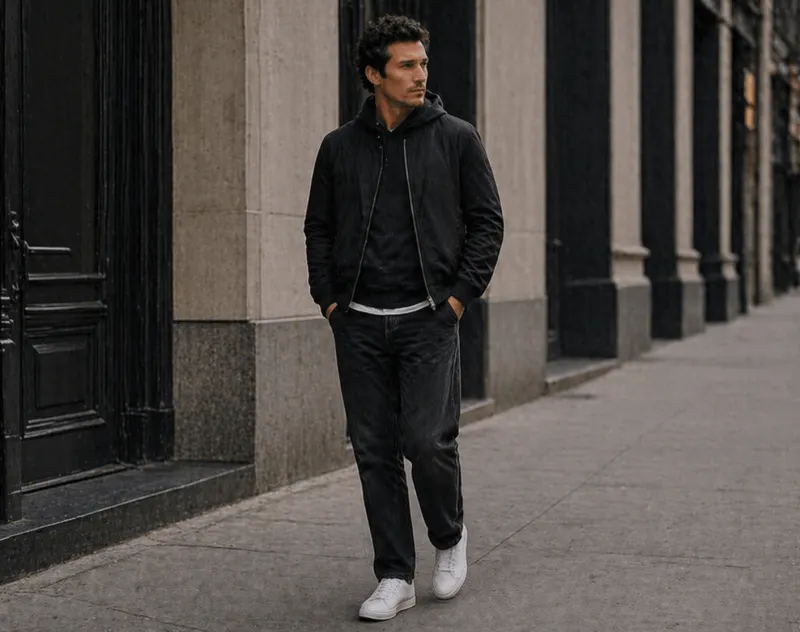
Streetwear with the volume turned down.
Hoodies, clean jeans or chinos, simple sneakers, bombers or unbranded technical jackets, the occasional cap. The silhouette and the ease of streetwear are preserved, but the graphics, the oversize logos, and the drop-culture signifiers are stripped out. Palettes narrow to black, grey, cream, olive, and navy; garments are chosen for cut and weight rather than brand. The effect is contemporary urban without subcultural announcement.
The register emerged in the 2010s as mainstream streetwear matured and the original audience (mid-30s urban professionals who had grown up with skate and hip-hop culture) wanted the silhouette without the branding. Brands like A.P.C., Our Legacy, Norse Projects, Stüssy’s quieter lines, and the output of figures like Kim Jones in his non-luxury work sit at the centre of the category. It borrows heavily from Japanese street labels — Uniqlo’s better collaborations, Beams, and the quieter corners of the Harajuku tradition — which never embraced North American logo-forwardness in the first place.
Street casual is the dominant code of urban 20s–30s life in most European and East Asian cities, and its failures are usually quiet ones: proportions that miss (a hoodie cropped too short, jeans too skinny for the current moment), or the accidental creep of streetwear signifiers back into an outfit that was supposed to refuse them. Its neighbours are casual (less deliberate in silhouette) and streetwear proper (the same garments with the branding turned back on).
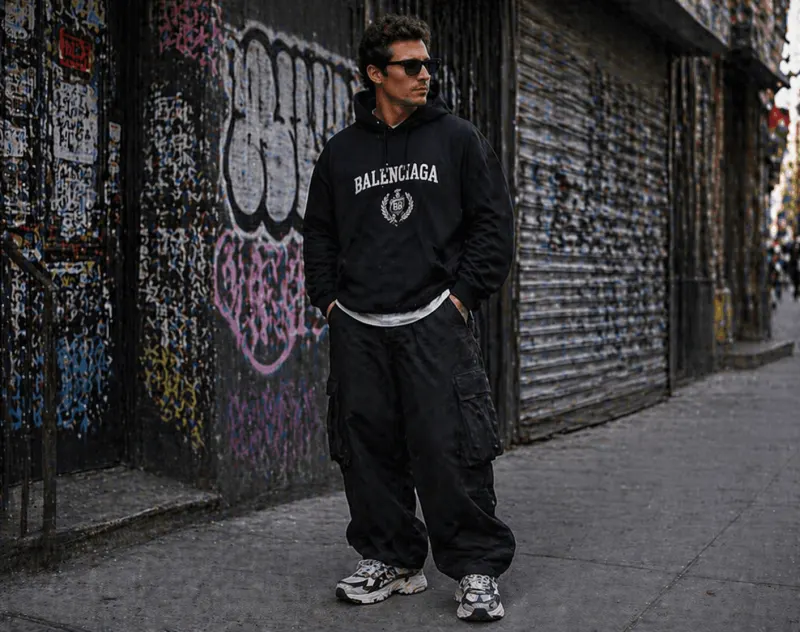
Branded by design, not accident.
Graphic tees, logo hoodies, cargo or wide-leg pants, chunky sneakers, branded outerwear. Branding is not incidental — it is the structural content of the style. A visible logo or graphic is how a streetwear outfit signals taste and affiliation, the same way a school tie once signalled class position. Strip the branding and the silhouette survives but the category does not.
The category crystallised in early-1980s Southern California around Shawn Stüssy’s Laguna Beach surfboard label, which became apparel around 1984. Hip-hop culture amplified the register through the late 1980s and 1990s — Dapper Dan’s Harlem reappropriations of luxury logos, FUBU, Wu-Tang, and the entry of sneaker culture into mainstream taste. The Japanese scene (A Bathing Ape, Neighborhood, Hiroshi Fujiwara’s Fragment Design) layered a craft-and-scarcity ethic on top through the 1990s, which later became Supreme’s operating model once New York adopted it.
The category has since forked. Mass streetwear (Supreme, Stüssy, Palace) runs on weekly drops, queues, and subcultural loyalty. Luxury streetwear (Balenciaga under Demna, Off-White, Fear of God) runs the same garment grammar through fashion-house distribution at three to five times the price. The grammar is shared; what differs is which channel does the signalling — subcultural affiliation on one side, fashion-house prestige on the other.
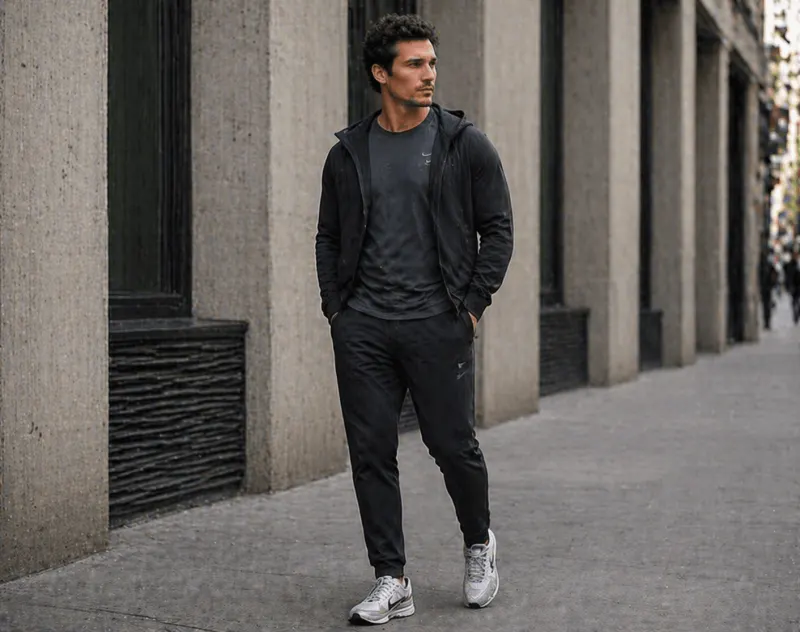
Performance fabrics worn outside the gym.
Technical joggers, moisture-wicking T-shirts, lightweight zip-ups and hoodies, running or trainer-style shoes, occasional shell layers. The fabric does the work: stretch, breathability, and the visible language of athletic gear — taped seams, reflective hits, seamless construction — become the aesthetic, whether or not the wearer has any intention of exercising.
As a commercial category, athleisure crystallised in the early 2010s around Lululemon’s women’s line and the men’s market that followed, with Nike, Adidas, and Under Armour all building lifestyle ranges that bridged gym and street. Outdoor Voices, Vuori, and Alo Yoga carried the next wave; the category overlapped with the 2010s boom in dedicated running brands (On, Hoka, Salomon’s return to street visibility) whose shoes migrated from race day into everyday rotation. By the 2020s, the trouser half of the category — technical joggers and sweatpants cut to a neat fit — had displaced casual chinos in a large share of remote-work wardrobes.
Athleisure is comfort-first, and its failures are usually about context rather than composition — worn somewhere that expects a jacket, or combined with pieces that pretend to more than the outfit can carry. It blurs with street casual at the upper edge (swap the joggers for denim and the category tips over) and with tech-minimalism when the palette goes monochrome and the fabrics turn matte.
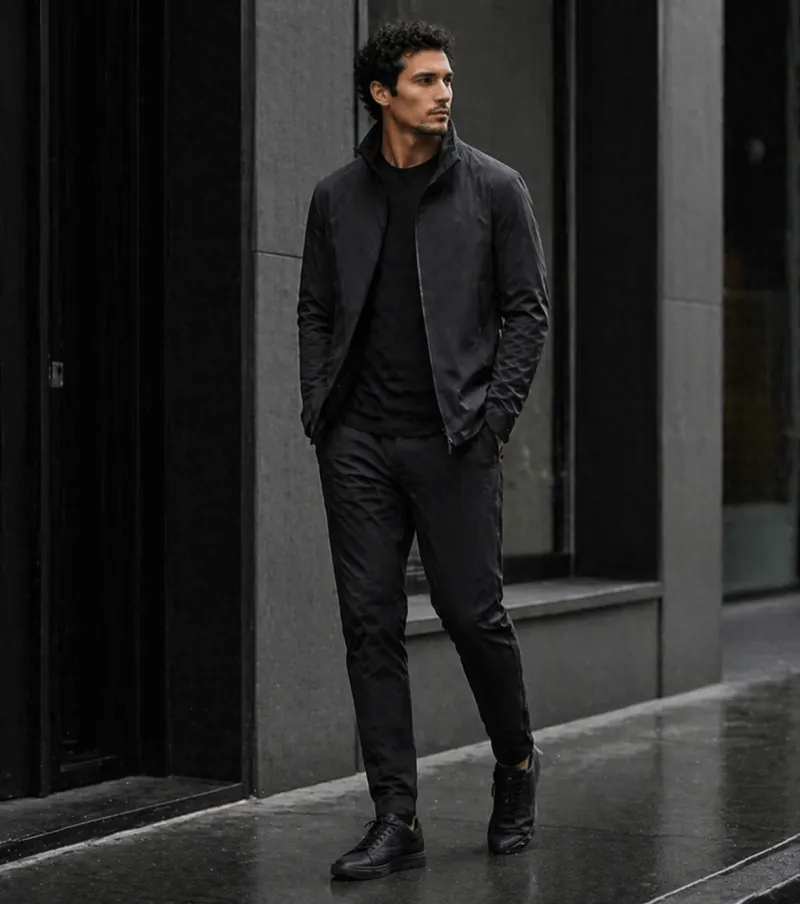
Technical fabric with its outdoor signifiers stripped.
Matte shell jackets, tapered nylon or softshell trousers, monochrome runner-style sneakers, thin merino or technical knits as base layers. The garments are built with outdoor-industry fabrics and construction — Gore-Tex, laminated seams, articulated knees — but the outdoor signifiers are absent: no bright rescue colours, no visible branding, no external storage panels. The palette is black, graphite, bone, olive at its most adventurous.
The canonical reference points are Arc’teryx’s Veilance sub-label (launched 2009, black-on-black urban technical wear), Stone Island Shadow Project (the Errolson Hugh-directed line from 2008 onward), and Acronym (Errolson Hugh and Michaela Sachenbacher’s own brand, founded 1994, which sits adjacent but louder and more explicitly architectural). A second wave — Nike’s ACG rebuilt under Hugh, Snow Peak’s urban line, and the quieter corners of Descente Allterrain — has normalised the register. Y-3, Adidas’s long-running collaboration with Yohji Yamamoto founded in 2003, sits on the avant-garde edge of the same category.
Tech-minimalism fails when the technical signalling becomes too theatrical — too many straps, too much visible hardware — and the outfit slides into techwear proper or costume-tactical territory. It sits in the overlap between minimalism and gorpcore, and refuses both the logo-forwardness of streetwear and the colour-popped rescue-signal aesthetic of gorp. Its neighbours are minimalism (same palette, natural fibres instead of technical) and gorpcore (same fabric family, noisier and more overtly outdoorsy).
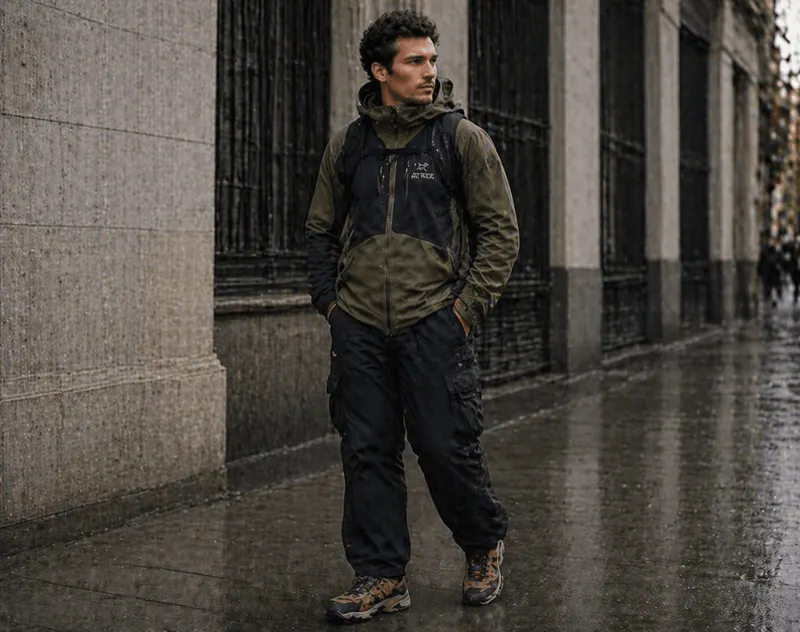
Mountain kit worn in cities with no intention of hiking.
Shell jackets in bright or contrasting rescue colours, fleece pullovers — Patagonia Synchilla, Arc’teryx Covert — cargo pants, trail-running shoes from Salomon or Hoka or La Sportiva, technical backpacks worn as an outfit element rather than luggage. The vocabulary is borrowed directly from hiking and mountaineering, but the wearer is on a subway platform.
The term gorpcore (from “good old raisins and peanuts”, the traditional American trail mix) was popularised around 2017 in American style writing, though the underlying phenomenon — outdoor brands as fashion — had been building through the 2010s. Patagonia, The North Face, Arc’teryx, Salomon, and Klättermusen all saw their city-dweller customer base expand past their mountain one; Japanese retailers like Nanamica and Beams had been running the same combination since the 1990s. The Salomon XT-6, the Hoka Bondi, and the Arc’teryx Beta jacket function as the canonical signifiers of the category’s mid-2020s peak.
Gorpcore is louder than it looks, because the signifiers are specific and the wearer is legible at a distance to anyone who knows the vocabulary. It fails when the outfit becomes a uniform of recognisable pieces rather than a considered combination, or when the palette loses its outdoor rationale (rescue orange without context looks like costume). Its neighbours are tech-minimalism (quieter, monochrome) and street casual (same silhouette, less committed to the outdoor reference).
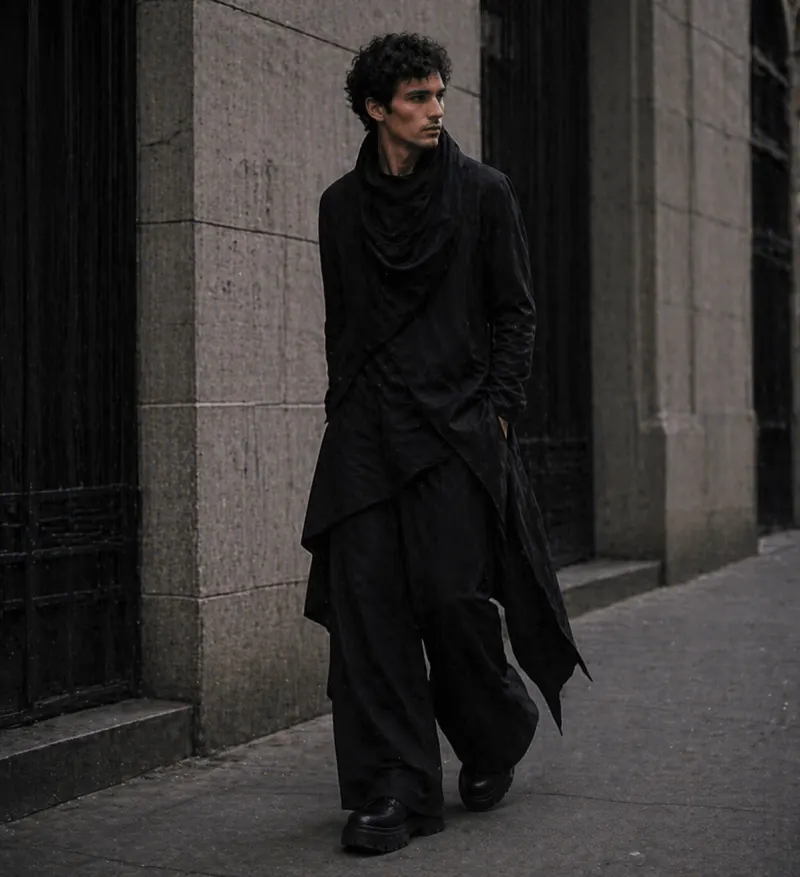
Structural experiment as the organising idea.
Unusual proportions and conceptual garments — elongated coats, asymmetric hems, draped layers, distorted shoulder lines, trousers cut wide enough to read as skirts from certain angles. Often in a dark palette (Rick Owens, Yohji Yamamoto, Ann Demeulemeester), but not necessarily: Comme des Garçons and Junya Watanabe work freely across colour, and Raf Simons’s collections from his own label and his house tenures have swung through both poles. What unifies the category is structural experiment rather than hue.
The category has two main roots. The Japanese designers who arrived in Paris around 1981 — Rei Kawakubo with Comme des Garçons and Yohji Yamamoto — proposed garments built on principles the European tradition had not used: asymmetry, deliberate wear, negative space, oversized proportion. The Antwerp Six (Dries Van Noten, Ann Demeulemeester, Dirk Bikkembergs, Walter Van Beirendonck, Dirk Van Saene, Marina Yee) emerged from the Royal Academy of Fine Arts in the same decade and pushed deconstructed tailoring through the European system. Rick Owens, from 2002 onward, added a Californian gothic-minimal register that has become one of the most recognisable strands in the current landscape.
Avant-garde reads as costume outside the subculture — it is the style most likely to draw open stares in a provincial high street — and a coherent wardrobe inside it. It fails when the wearer owns isolated statement pieces but not a vocabulary to put them in conversation with; a single Rick Owens coat over generic basics looks borrowed rather than worn. Its neighbours are soft tailoring (same drape language, subtler) and a certain wing of streetwear (the luxury-house strand that shares the oversize silhouette but not the philosophy).
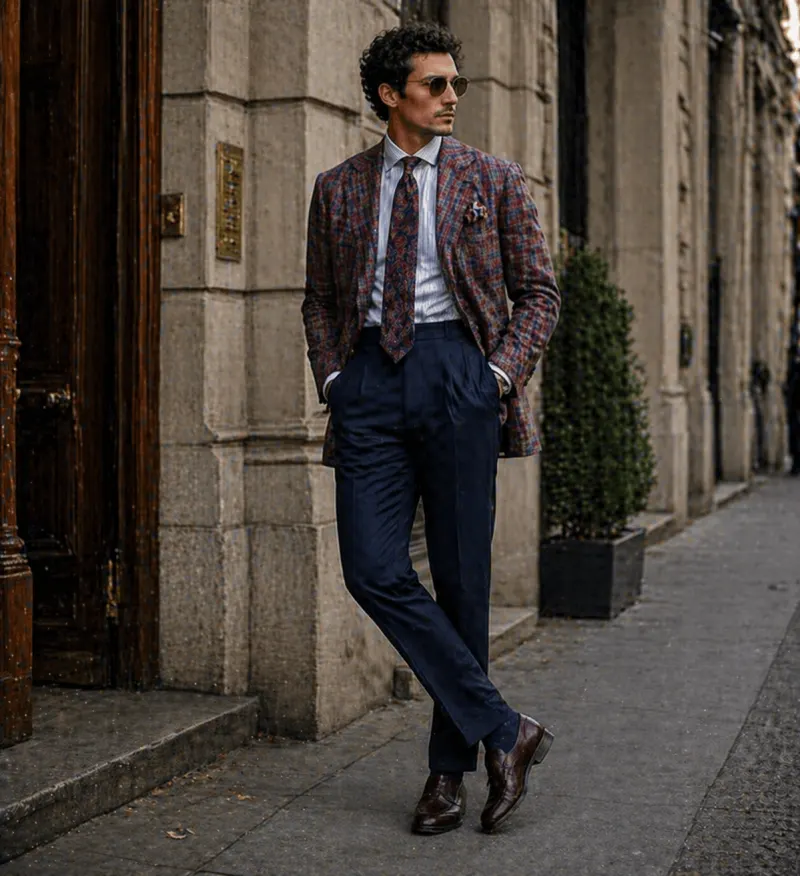
Classic tailoring pushed toward maximum expression.
Bold patterns — glen checks at high contrast, vivid windowpanes, broad stripes — saturated colour in jackets and accessories, mixed textures layered deliberately (velvet, silk, tweed, corduroy in a single outfit), pocket squares folded with visible intent, ties in colours that announce themselves, occasional hats worn without irony. The grammar is classic sartorial; the dial is turned to maximum.
The figure of the dandy traces to Beau Brummell in Regency London around the 1810s, whose insistence on fit, cleanliness, and restrained precision actually inaugurated the modern dark suit — the historical dandy was not a peacock. The peacock strand layered over the top more recently, most visibly through the crowd that gathers at Pitti Uomo in Florence twice a year (Lino Ieluzzi of Al Bazar, and the international sartorial figures photographed at the fair since the 2000s), with Gianni Agnelli as the cross-generational patron saint of loud-but-unforced classic dress. The revival has its own critical commentary from writers like Derek Guy (whose Die, Workwear! archive contains the best sceptical reading of the register) and Simon Crompton at Permanent Style.
The dandy register is rare in daily life and common at weddings and in menswear media, where it performs well on camera. It is easy to caricature and hard to do well: the failure mode is the costume reading — too many signifiers fighting for attention, or a combination that reads as fancy dress rather than as considered dress. Its adjacent styles are classic sartorial (the quieter version of the same vocabulary) and, at the edges, avant-garde (a different kind of loud, through silhouette rather than pattern).
Most men spend most of their time inside a narrow band: middle-to-lower formality, quiet, era-neutral, slightly relaxed silhouette, with origins pulled from sportswear and workwear. Casual and street casual do most of that work at the weekend; business casual and smart casual fill the weekday. The rest of the map is entered for a specific occasion — a job, a ceremony, a subculture, or a particular aesthetic project.
The practical use of the map is diagnostic. When an outfit doesn’t land, the cause is usually one piece off on a single axis — louder than the rest, or more contemporary, or more tailored.