 LAPEL The Colour LAPEL The Colour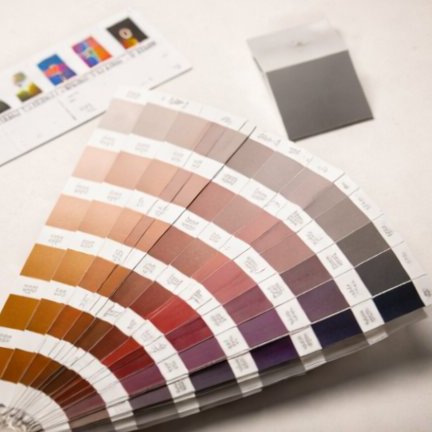
If I say “dark blue,” you might picture navy, cobalt, midnight, or royal blue. The problem is as old as commerce itself: colour names are subjective, culturally variable, and hopelessly imprecise. When you are dyeing 10,000 meters of fabric, matching paint to a corporate logo, or ensuring a car’s bumper matches its body panels across different manufacturing plants, “dark blue” is not good enough. You need an unambiguous, reproducible specification.
Over the past century and a half, different industries have developed their own systems to solve this problem. Each system is optimised for a specific medium — because colour on a screen, colour in ink, colour in fabric dye, and colour in architectural paint all behave differently. There is no single universal system, because the physics of colour reproduction is fundamentally different across media.
Developed by artist and educator Albert Munsell in 1905, the Munsell system was one of the first attempts to organize colour scientifically based on human perception. It describes any colour using three independent dimensions: Hue (the colour family — red, yellow, green, blue, purple), Value (lightness, from black to white), and Chroma (saturation or intensity).
What makes Munsell special is that it is perceptually uniform — equal steps in the system correspond to equal perceived differences in colour. It is still used today in soil science (the USDA classifies soil colour with Munsell charts), fine art, and any field where human visual perception is the standard.
In the 1930s, the Inter-Society Color Council and the U.S. National Bureau of Standards set out to solve a deceptively simple problem: how do you name colours in a way that is precise enough for scientists yet plain enough for everyone else? The result was the ISCC–NBS system — 267 named colour categories built on top of Munsell colour space.
The system works by combining 13 basic colour terms (red, orange, yellow, green, blue, violet, purple, pink, brown, olive, plus white, grey, and black) with intuitive modifiers like “vivid,” “pale,” “dark,” “light,” and “deep.” Every possible colour maps to exactly one category with no overlaps. The beauty of the system is its readability — a designation like “dark yellowish brown” or “vivid purplish blue” immediately communicates the colour to anyone, without special training or reference charts. It remains widely used in botany, geology, archaeology, and forensic science.
In 1931, the Commission Internationale de l’Éclairage (CIE) developed the first mathematically defined colour space based on human colour perception experiments. The CIE system does not rely on physical samples — it defines colour as a set of coordinates in a mathematical space. The CIE XYZ colour space encompasses all colours visible to the average human eye.
Later refinements include CIELAB (L*a*b*), designed to be perceptually uniform and widely used in quality control, and CIE Delta E, a formula that quantifies the perceived difference between two colours. When a paint manufacturer says two batches are “within tolerance,” they mean the Delta E between them is below a threshold. CIE is the foundation on which most modern colour management is built.
Pantone Matching System (PMS), introduced in 1963, solved a very practical problem: how can a designer in New York specify a colour and know that a printer in Tokyo will reproduce it exactly? Pantone assigns each colour a unique numeric code (e.g., Pantone 186 C for Coca-Cola red) and provides physical swatch books printed with calibrated inks.
Pantone is used across graphic design, fashion (with separate textile swatch books — TPX and TCX series), product design, and branding. It is proprietary — you buy the swatch books, and the colour definitions are copyrighted. The annual Pantone Colour of the Year announcement has become a cultural event that influences fashion, interior design, and consumer products globally.
The RAL colour system (from the German Reichs-Ausschuß für Lieferbedingungen, roughly “National Committee for Delivery Terms”) was created in Germany in 1927 to standardise colours for industrial use. Its original collection of 40 colours has grown to over 2,500 in the RAL Design system.
RAL is the dominant colour standard in architecture, construction, industrial coating, and powder coating across Europe. When you order a metal railing, facade panel, or industrial machine, colours are specified in RAL numbers. RAL 9010 (Pure White) and RAL 7016 (Anthracite Grey) are among the most commonly used colours in European architecture.
The Natural Colour System (NCS), developed in Sweden and based on the opponent-colour theory of Ewald Hering, describes colour the way humans naturally perceive it. Every colour is defined by its visual resemblance to six elementary colours: white, black, yellow, red, blue, and green.
NCS is particularly popular in Scandinavian countries and is widely used in interior design, architecture, and urban planning. Its strength is intuitiveness — a designer can read an NCS code and immediately understand what the colour looks like without needing a physical swatch.
Screens produce colour by mixing light from red, green, and blue subpixels — the RGB model. Each channel can range from 0 to 255, giving roughly 16.7 million possible colours. HEX codes (like #FF5733) are simply a compact way of writing RGB values in hexadecimal notation.
RGB is additive — mixing all three at full intensity produces white. This is the opposite of how paint works. Related systems include HSL (hue, saturation, lightness) and HSB/HSV (hue, saturation, brightness), which describe the same colours but in a way that is more intuitive for designers — it is easier to think “make this 10% lighter” in HSL than to figure out which RGB values to change.
Printing uses CMYK — cyan, magenta, yellow, and key (black). Unlike screens, printed colour is subtractive: each ink absorbs certain wavelengths, and what is reflected back is what you see. In theory, mixing cyan, magenta, and yellow should produce black, but in practice the result is a muddy brown — hence the addition of a separate black ink (K).
This is why a colour that looks vibrant on your monitor can appear dull when printed. The colour gamut (range of reproducible colours) of CMYK is significantly smaller than RGB. Professional designers routinely work in both spaces and use colour profiles (ICC profiles) to manage the translation between them.
No single system can do everything. Munsell and NCS describe how we see colour. CIE provides the mathematical foundation. Pantone and RAL enable precise communication across supply chains. RGB and CMYK are the practical systems for screens and print. They coexist because colour itself is not one thing — it is physics, perception, technology, and convention, all tangled together. Understanding which system to use and when is part of the craft of working with colour professionally.