 LAPEL The Colour LAPEL The Colour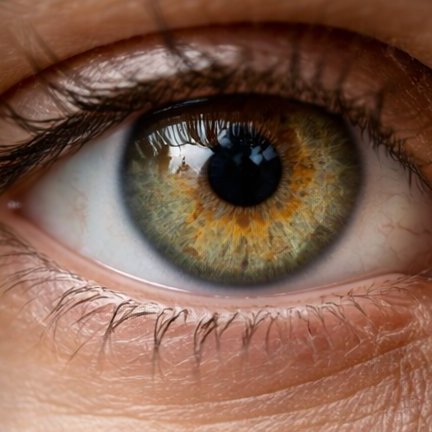
The light reaches your eye and stops being physics. From there it’s biology — molecules in the back of your eye bending in response to photons, signals racing up the optic nerve, a brain stitching them into the experience you call “colour.” Two people in the same shop staring at the same blazer can be processing measurably different signals. Before any of this is about cloth or taste, it’s about the apparatus you happen to have.
Before light became something to see, it was something to eat. Photosynthesis — plants, algae, and some bacteria capturing photons and converting their energy into sugars — built the world that everything else lives in. The food you eat and the air you breathe both exist because, somewhere down the chain, life learned to harvest light.
The molecule responsible is chlorophyll, and chlorophyll is picky about what it absorbs. It takes red and blue wavelengths efficiently — where the sun’s radiation is most intense and most useful for driving chemical reactions — and bounces green straight back. Which is why almost everything that photosynthesises looks green to us. We’re seeing the wavelengths chlorophyll didn’t want.
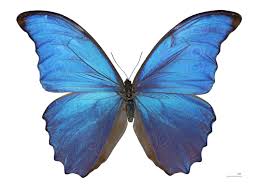
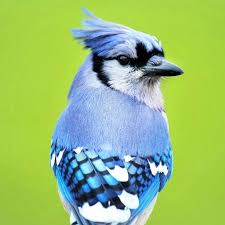
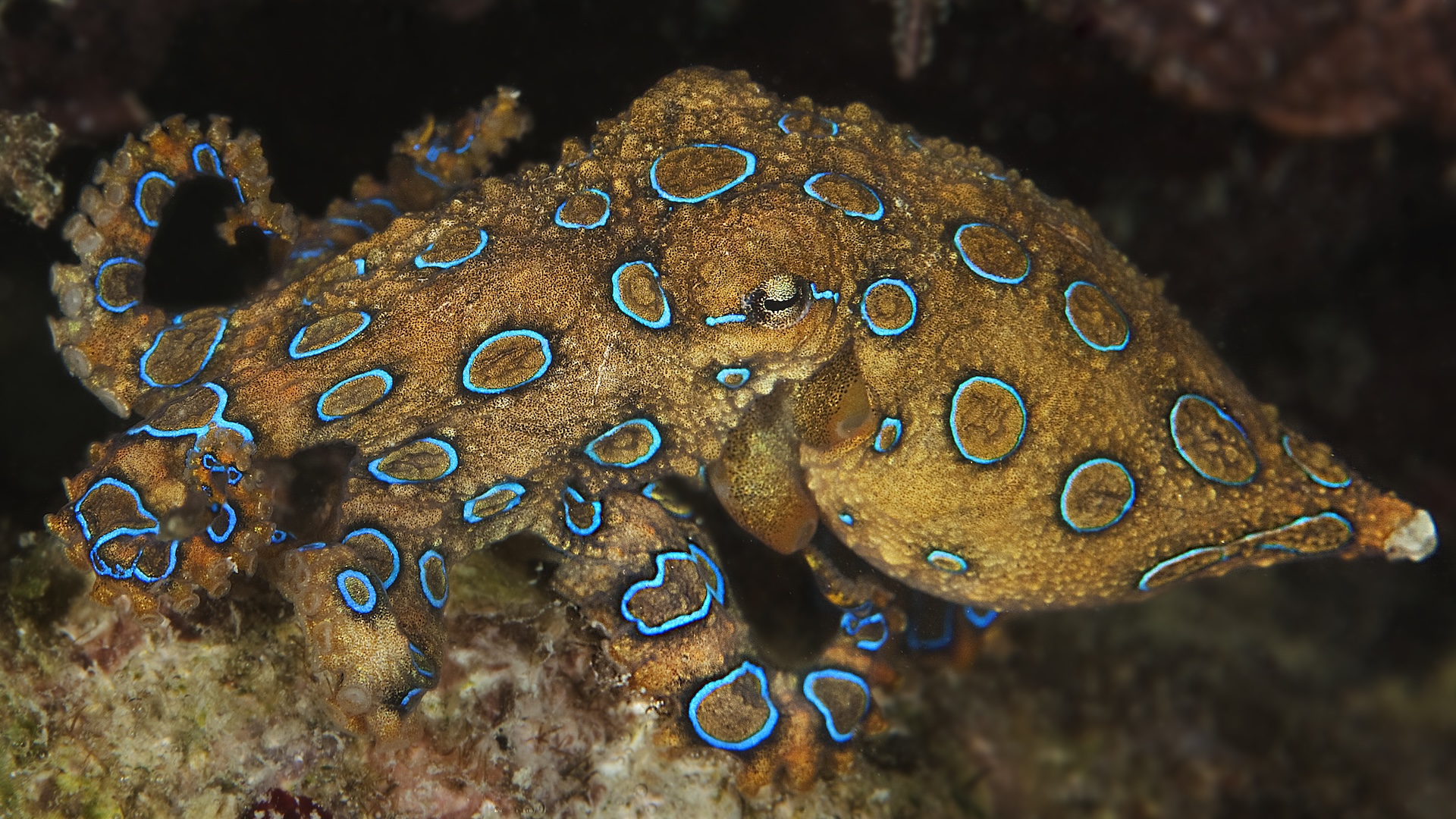
Blue is the rarest colour in the natural world. The sky and the ocean look blue, but neither contains a single drop of blue pigment — that colour comes from Rayleigh scattering, the same trick that makes sunsets red. Real blue pigment is extraordinarily hard for biological systems to produce. Almost every blue you see in an animal — the iridescent wings of a Morpho butterfly, the feathers of a blue jay, the warning rings of a blue-ringed octopus — is structural colour: microscopic ridges and lattices on the surface that interfere with light waves and reflect just the blue wavelengths back. The animal isn’t dyed blue. It’s built blue.
Blue flowers are rare for the same reason. The few that exist mostly get there by complicated pH manipulation of pigments like anthocyanins, not by synthesising a blue molecule directly. There are almost no naturally blue minerals and very few organisms that use real blue pigment. Across cultures, blue has often been treated as the most special, most sacred, most reserved colour. The biology may have something to do with that — what is hard to make, we tend to value.
The eye is a biological camera, but the interesting part isn’t the lens or the iris — it’s the retina, a thin sheet of nervous tissue lining the back of the eyeball. The retina contains two kinds of photoreceptors, and they do completely different jobs.
~120 million per eye. Extremely sensitive to light, responsible for vision in dim conditions. They do not distinguish colour — only brightness. This is why everything looks grey in near-darkness.
~6–7 million per eye. Responsible for colour vision. They come in three types, each sensitive to a different range of wavelengths: S-cones (short, ~420 nm — blue), M-cones (medium, ~530 nm — green), and L-cones (long, ~560 nm — red). The brain interprets colour by comparing the relative activation levels of all three cone types.
The chemistry that makes any of this work is rhodopsin in the rods, and a family of related pigments called photopsins in the cones. Both are built from a protein called opsin combined with retinal — a molecule your body assembles from vitamin A. A photon hits rhodopsin, the retinal literally bends shape, that mechanical change triggers an electrical signal, and the signal travels up the optic nerve to the brain. The whole sequence runs in trillionths of a second. This is why severe vitamin A deficiency causes night blindness: the rods run out of raw material to keep regenerating their light-sensitive molecules.
So how many colours can you actually see? Roughly a million. The math is rough but defensible — each cone type discriminates around a hundred levels of intensity, three cones gives you a hundred cubed, and that lands close to a million. The exact number depends on the density and health of your particular cones, the lighting you happen to be under, and how much time you’ve spent paying attention. Under laboratory conditions some estimates push the upper bound to two or three million. Under fluorescent lighting at the end of a long day, you can probably resolve closer to ten thousand.
Some people have one or more cone types missing or non-functional. The condition is called colour vision deficiency, or daltonism after John Dalton, the chemist who first described his own deficiency in 1794. The genes for the M-cone (green) and L-cone (red) sit on the X chromosome, which is why daltonism is dramatically more common in men (~8%) than in women (~0.5%). Men have one X. A single defective gene has no backup.
Missing or defective L-cones (red). Red appears dark or brownish. The most disorienting type for everyday life.
Missing or defective M-cones (green). The most common form. Greens and reds are confused, but brightness perception is normal.
Missing or defective S-cones (blue). Very rare. Blues and yellows are confused. Not linked to the X chromosome.
Complete absence of functioning cones. Extremely rare (~1 in 30,000). The world appears entirely in shades of grey.
Most people with mild daltonism don’t realise they have it for years. The brain papers over the missing channel by leaning harder on the others — context, brightness, learned associations. You can usually identify a colour-blind person by the questions they ask about their own clothes rather than by the answers they give.
The reverse case is much rarer. Most humans are trichromats with three cone types; a small percentage of women may be tetrachromats, with four. The mechanism mirrors daltonism: the M and L cone genes both live on the X chromosome, women have two of those, which gives them a chance — slim but real — of carrying a fourth cone gene with a slightly shifted sensitivity, slotted between the standard M and L.
Up to 12% of women may carry the genetic potential. Far fewer appear to be functional tetrachromats — meaning their brains actually exploit the fourth cone to make distinctions the rest of us can’t make. Functional tetrachromats reportedly see something like a hundred million colours, against the million the rest of us get. They pick out subtle shade differences in fabric, paint, and skin tone that look identical to a trichromat. The textile and cosmetics industries quietly recruit for this.
Humans don’t have especially good colour vision by any cosmic standard. Different species evolved their visual systems for different jobs:
Have 16 types of colour receptors (compared to our 3), including sensitivity to ultraviolet and polarized light. They see a world of colour far beyond our comprehension.
Cannot see red but can see ultraviolet. Flowers that look plain white to us display vivid UV patterns that guide bees to nectar.
Dichromats — they have two cone types and see roughly the equivalent of red-green colour blindness in humans. They distinguish blue and yellow well, but red and green look similar.
Most birds are tetrachromats with a UV-sensitive cone. They see ultraviolet patterns in feathers that are invisible to us, which play a role in mate selection.
Some pit vipers have infrared-sensing pit organs, giving them a "thermal image" of the world overlaid on their visible vision.
Octopuses and cuttlefish are technically colour-blind (one cone type) yet are masters of camouflage. They may perceive colour through their skin or by detecting the polarization of light.
Across species, colour does the same handful of jobs — attracting mates, warning predators off, hiding from them, finding food — and the visual system is shaped by which of those jobs mattered most in the species’ history. Bees see ultraviolet because flowers paint themselves in it. Dogs barely see red because nothing they ever needed to identify was. Mantis shrimps see far more than they could plausibly need, and nobody has quite figured out why.
Colour perception varies. It varies between species (mantis shrimps see things you never will), between individuals of the same species (8% of men miss part of the red-green channel; somewhere between 1% and 12% of women may have an extra cone), and within a single individual across age, lighting, fatigue, and practice. Painters and dyers get measurably better at distinguishing shades the more time they spend doing it.
The practical consequence: when you and your partner disagree about whether a shirt is navy or black, you may both be right. The retina has three colour channels and an enormous amount of post-processing wired in behind them, and most of the disagreements are happening in the post-processing.
Which is the next article.